
Field Fluency: The Leadership Advantage AI Cannot Automate
Debate about artificial intelligence at work is often breathless or fearful. A better question is this: as software takes on more coordination, how does field fluency make human leadership more valuable?
Field work depends on people who can read conditions, make technical judgments, protect one another, work within their authority, and respond when a plan meets reality.
AI can organize schedules, retrieve service history, summarize notes, draft customer updates, flag anomalies, and reduce administrative friction. The International Labour Organization’s task-based analysis cautions against the easy story that occupations simply disappear: job transformation is the more likely broad effect, while clerical occupations have the highest exposure. The World Economic Forum likewise projects frontline roles, including construction workers, among the largest sources of absolute job growth through 2030.[1][2]
As routine office work becomes easier to automate, the enduring advantage is leading people where the work happens. This complements the argument in The Field Stays Human. The Office Gets Intelligent.: technology should remove friction without displacing accountable human judgment.
I call that capability field fluency. It is not a manager pretending to be the best technician. It is not a photo opportunity. It is the disciplined ability to understand the conditions in which people are asked to perform—and to make better decisions because of that understanding.
Field fluency is the disciplined ability to understand the conditions in which people are asked to perform—and to make better decisions because of that understanding.
Human prompting when the answer cannot wait
Jacob Morgan proposes human prompting as a structured practice of asking questions that activate people’s cognitive and moral capacities. His distinction is useful: prompt engineering seeks better outputs from machines; human prompting seeks better thinking from people.[Morgan]
In the field, a changed condition, missing part, customer concern, or safety issue may require an answer before anyone can search a system or ask AI for a polished response. The goal is not improvisation beyond training or authority. It is the confidence to say: Here is what I see. Here is the risk. Here is what I can responsibly do. Here is what needs escalation. For an immediate hazard, stop work and follow the required escalation process.
Leaders can ask: What do you notice? What is missing? What standard applies? What is within your authority? What do you recommend, and why? Who needs to know? The questions help a leader hear reasoning rather than mistake a polished answer for understanding.
The workday looks different from the route
In pool service, landscaping, plumbing, construction, HVAC, electrical service, facilities management, and related industries, a workday is rarely a clean series of appointments. It may involve travel, weather, changing job conditions, incomplete information, equipment trouble, materials that are not where they should be, and customers who understandably want their problem solved now.
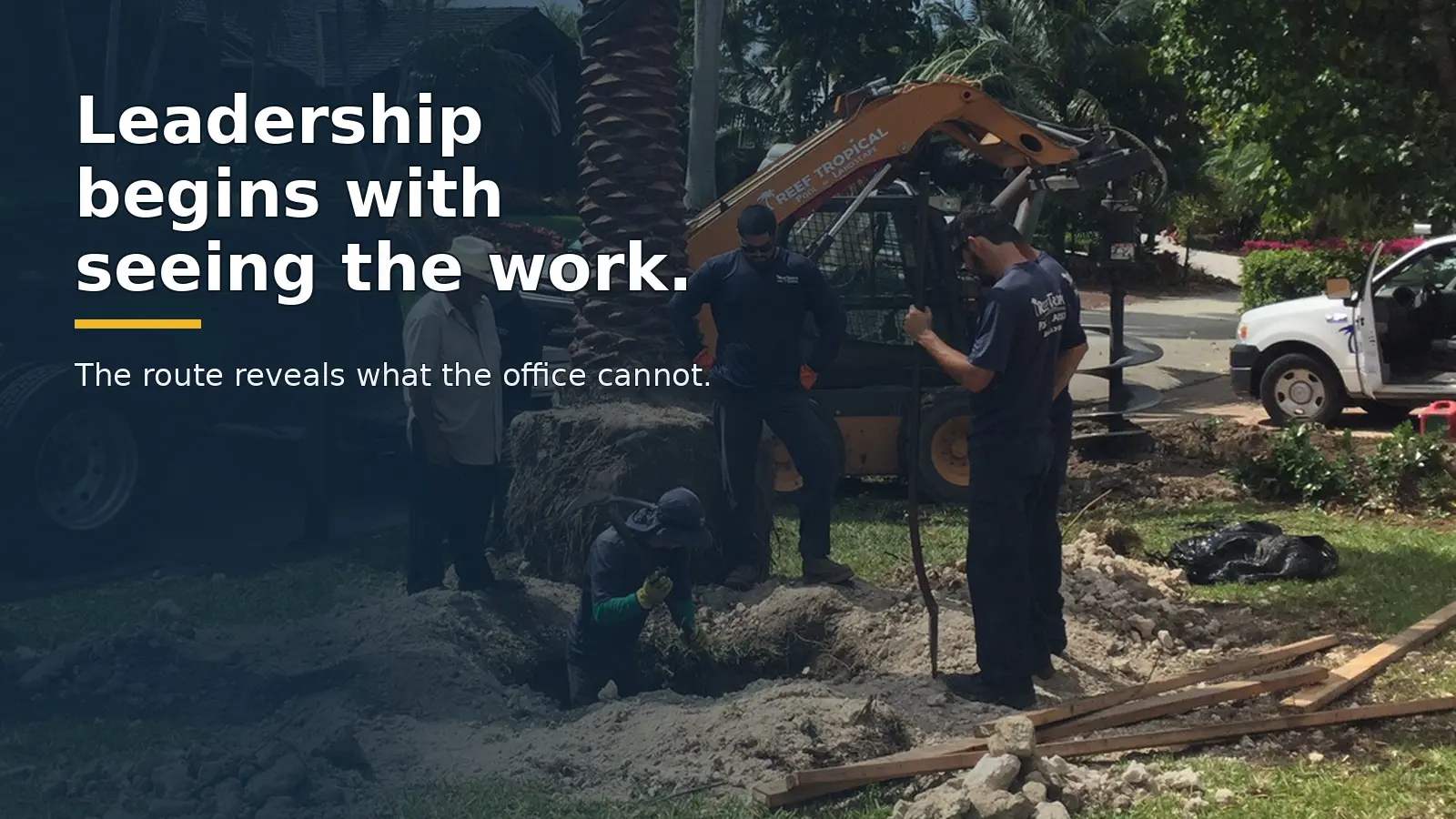
For heat-exposed work, heat and humidity are not background scenery. OSHA explains that risk reflects workload, temperature, humidity, sunlight or radiant heat, air movement, clothing/PPE, acclimatization, and individual factors—not merely the thermometer. Construction and landscaping are among affected sectors.[3] NIOSH notes that heat can contribute to injury through fatigue, dizziness, sweaty hands, fogged safety glasses, and PPE changes.[4]
A field employee may need to meet the route or production target, work safely, document the job, preserve quality, handle the customer professionally, and absorb a schedule change. Leaders should learn which demands their operating system is creating or intensifying. A scorecard cannot show every condition that shaped a day.[5]
A leader who has not seen this environment may still be well intentioned. But good intentions do not automatically produce good expectations. A decision made at a desk can become a burden carried on a driveway, roof, equipment room, job site, or customer’s front yard.
Field work is not “more real” than office work; every part of a business contributes. But dispatch sees the schedule, finance sees cost and margin, sales sees the customer promise, and the field sees whether those pieces fit or collide. A healthy organization brings those perspectives together before problems harden into rework, preventable risk, or resentment.
A field employee’s account deserves more than a polite listening session. It is operational input: neither automatic proof nor something to dismiss from a distance. Leadership should investigate the reported condition, compare it with the rest of the process, decide what the evidence warrants, and explain the decision. That is how respect and rigor work together.
A title can require a decision; it cannot substitute for a relationship with the people who must carry that decision into the work. The direct manager relationship is consequential, but it should not become favoritism or a substitute for a consistent process. Learn the conditions, apply the same standards, make the decision, and explain it to the people affected.[6]
Respect the craft before you try to improve the system
The field employee is not a passive recipient of office decisions. That premise also sits at the heart of Deemed Essential: meaningful work and the people who perform it deserve to be seen clearly. Skilled professionals carry technical knowledge, situational awareness, practical judgment, and customer intelligence that the organization needs. They know which route sequence repeatedly creates a bad handoff. They know when a work order is incomplete. They know which truck, tool, part, approval, or customer promise turns a reasonable job into an impossible one.
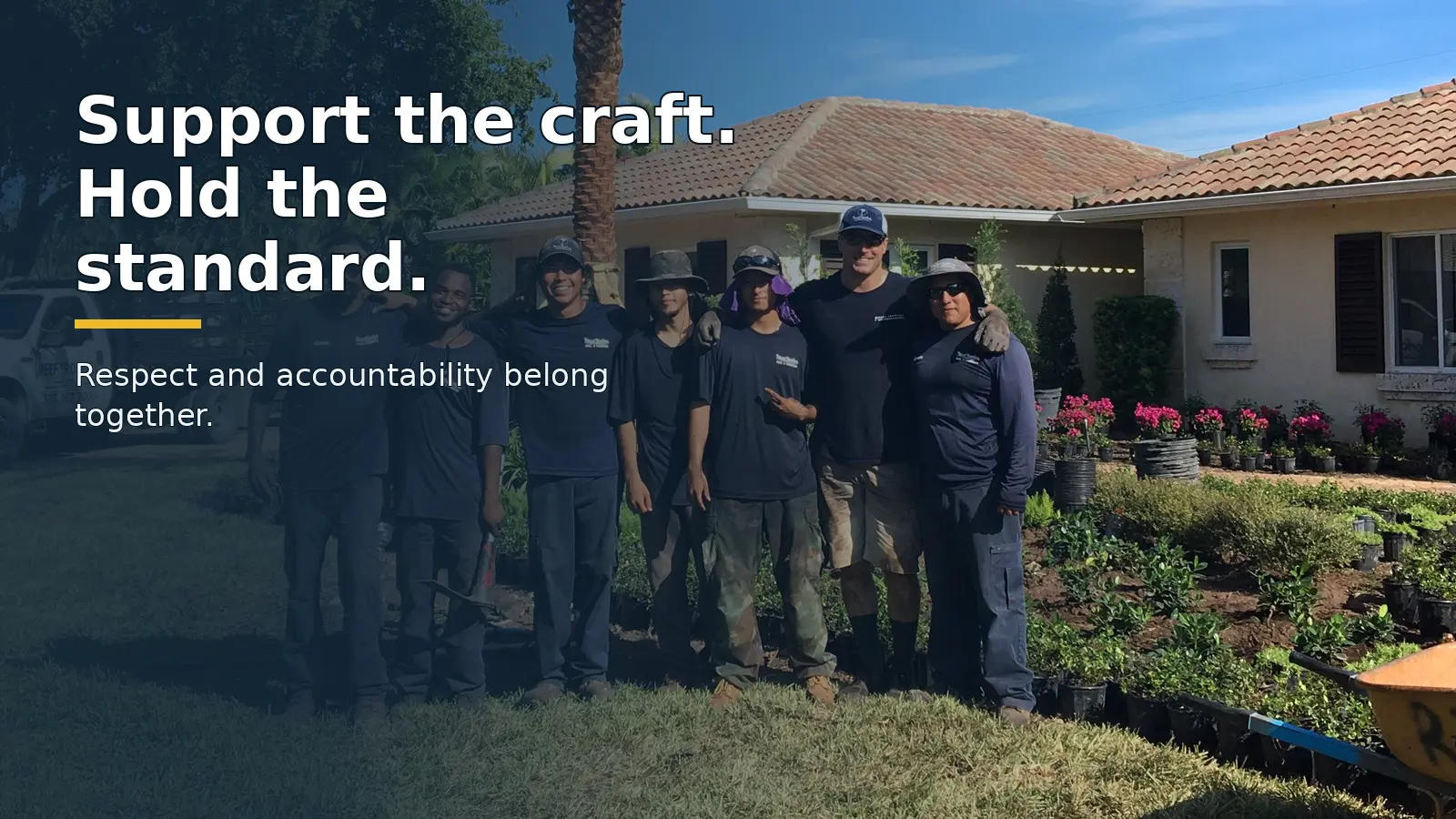
Research on work design offers a useful lens. Work contains demands that consume energy and resources that help people meet their goals—such as information, equipment, discretion, feedback, and support.[5] The practical implication is not that every difficulty can be removed. It is that leaders should learn to separate an individual performance problem from a design problem.
If a technician repeatedly arrives unprepared, accountability may be appropriate. But a manager should first ask: Was the job information correct? Was the required material available? Did the route create an unrealistic sequence? Was a customer commitment made without field input? Was the employee trained and authorized for the task? Did the equipment work? Was the standard clear?
That is not making excuses. It is refusing to confuse symptoms with causes.
Compassion is not the cancellation of consequences. It is the discipline of seeing the person and the conditions clearly before deciding what is fair. When a standard was clear, the employee had the necessary support and authority, and the failure was within that employee’s control, follow-through matters. When the system supplied bad information, inadequate equipment, conflicting priorities, or insufficient preparation, leadership has an obligation to repair its part as well. Both conversations should be direct, respectful, and documented.[7]
Theory X, Theory Y—and the trap of labeling people
Douglas McGregor’s The Human Side of Enterprise (1960) introduced Theory X and Theory Y as contrasting managerial assumptions about work and motivation.[8] The framework can be a mirror: do our systems assume people must be controlled, or do they create conditions for judgment, learning, and contribution?
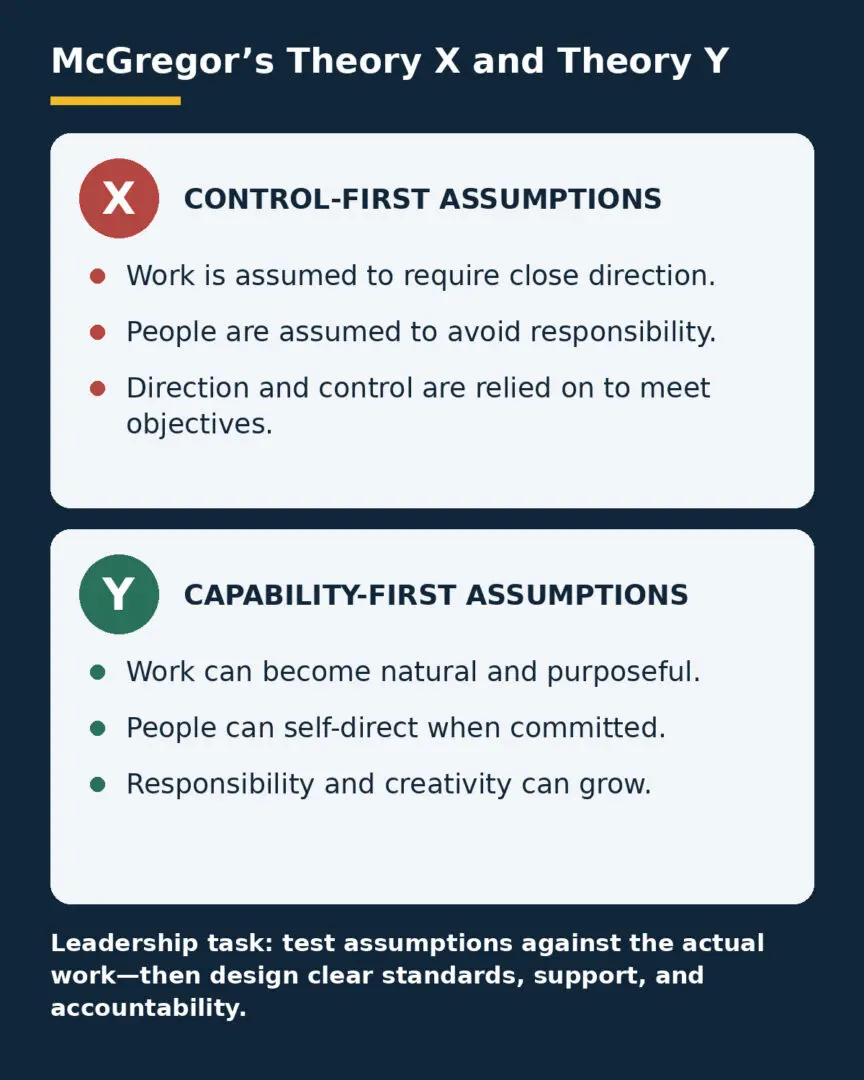
It is not a universal diagnostic, personality test, or license to divide a workforce into “good” and “bad” types. Field employees are neither a stereotype to manage by suspicion nor a romanticized class presumed to need no structure. The leadership task is to develop capability while applying fair verification and accountability.
That means clear standards, competent training, tools and information, documented follow-through, and a respectful chance to explain conditions. Check quality, safety, customer commitments, and documentation through consistent methods—not gossip, proximity, or a manager’s favorites. Development without verification can leave people unsupported; verification without development can become surveillance. Healthy teams need both.
Labor scarcity, retention, and reliable work
When an organization has difficulty filling roles or retaining experienced people, pressure can tempt leaders to treat every attendance or performance concern as a character flaw—or to tolerate recurring problems because a role is hard to replace. Neither is fair to the employee, crew, or customer.
Retention is not an excuse to lower safety and quality standards. It is a reason to clarify expectations, remove avoidable barriers, offer training and feedback, build escalation paths, and explain decisions. Justice research distinguishes fair outcomes from fair process, respectful treatment, and adequate explanation.[9] Those dimensions do not guarantee retention, but they guide hard decisions without needless disrespect.
Attendance and reliability matter because coworkers and customers feel their effects. But “reliable” should describe observable commitments—not a leader’s guess about commitment, health, family responsibilities, or character. Look at the expectation, record, notice, available support, and operational impact. Apply the same process to comparable situations, document the decision, and protect confidentiality.
Fitness-for-duty questions require still more care. A supervisor should not diagnose a person, speculate about a medical condition, or turn a safety concern into public labeling. Address immediate safety risks through the organization’s established procedure; record observable work facts; and involve qualified HR, safety, occupational-health, or legal resources as appropriate to the jurisdiction and policy. This is a management-process recommendation, not medical or legal advice. It preserves both safety and dignity.[14]
The positive case matters, too. A healthy team is not one with no difficult conversations. It is a team where people know the standard, can ask for clarity, report a hazard or mistake early, receive useful coaching, and see leaders correct system failures as well as individual ones. Psychological safety concerns whether people can take interpersonal risks—such as asking, admitting uncertainty, or reporting a problem—without interpersonal punishment. It is not comfort, agreement, or immunity from standards.[10]
Put on the boots—but do it with humility
Every manager responsible for field employees should spend recurring time in the operating environment. Call it a work-along, field day, ride-along, or operating immersion. The name matters less than the design.
First, it must be recurring. One visit teaches a manager that the field exists. Repeated visits can reveal patterns: the recurring information gap, equipment bottleneck, customer escalation rooted in an upstream promise, season when heat changes the pace, or handoff that quietly creates rework.
Second, it must be safe. A manager should not climb, lift, drive, repair, enter a restricted area, or perform technical work merely to demonstrate solidarity. Participation must be limited to work for which the person is trained, authorized, properly equipped, insured where applicable, and supervised. Often the wise role is to observe, ask, and learn under the guidance of an experienced employee.
Third, it must not be a disguised inspection. If a leader says, “I am here to learn what makes good work easier and harder,” then uses the visit primarily to catch errors, the organization will learn the wrong lesson. Psychological safety is not freedom from standards. It is the shared belief that people can raise a question, concern, mistake, or uncertainty without interpersonal punishment.[10]
Fourth, the leader must close the loop. Record what was learned. Separate quick fixes from structural issues. Assign an owner and a date. Report back on what changed, what did not change, and why. When the answer is no, give an honest explanation and offer the best available alternative. Organizational-justice research distinguishes between fair outcomes, fair processes, respectful treatment, and adequate explanation.[9]
Field fluency produces fairer accountability
Some leaders hear empathy and worry that standards will soften. They should not. The standard for safe, reliable, high-quality work should be clear. Customers deserve professionalism. Coworkers deserve reliability. The business requires follow-through.
But accountability detached from conditions becomes arbitrary. It says: “Meet the number; I do not care what made the number difficult.” That is not high performance. It is managerial distance.
Fair accountability asks a more demanding sequence of questions:
- What was expected, and was it clearly communicated?
- What conditions did the person actually face?
- What support, information, authority, equipment, and training were available?
- What choices were within the employee’s control?
- What must the employee change next time?
- What must leadership repair so the same failure is not manufactured again?
This preserves the difference between an unavoidable obstacle and avoidable poor performance. It gives coaching a factual foundation. And it makes consequences more credible because employees can see that the leader understands what the work requires.
Customer-facing work deserves special attention. Research identifies customer-related social stressors, including unreasonable expectations and verbal aggression; professionalism can involve regulating one’s response under difficult interactions.[11][12] Courtesy still matters. Organizations should establish clear escalation thresholds, give employees language and authority for de-escalation, and stand behind people who follow policy respectfully.
A practical operating rhythm
A field-fluent leadership practice need not be elaborate. It needs to be real.
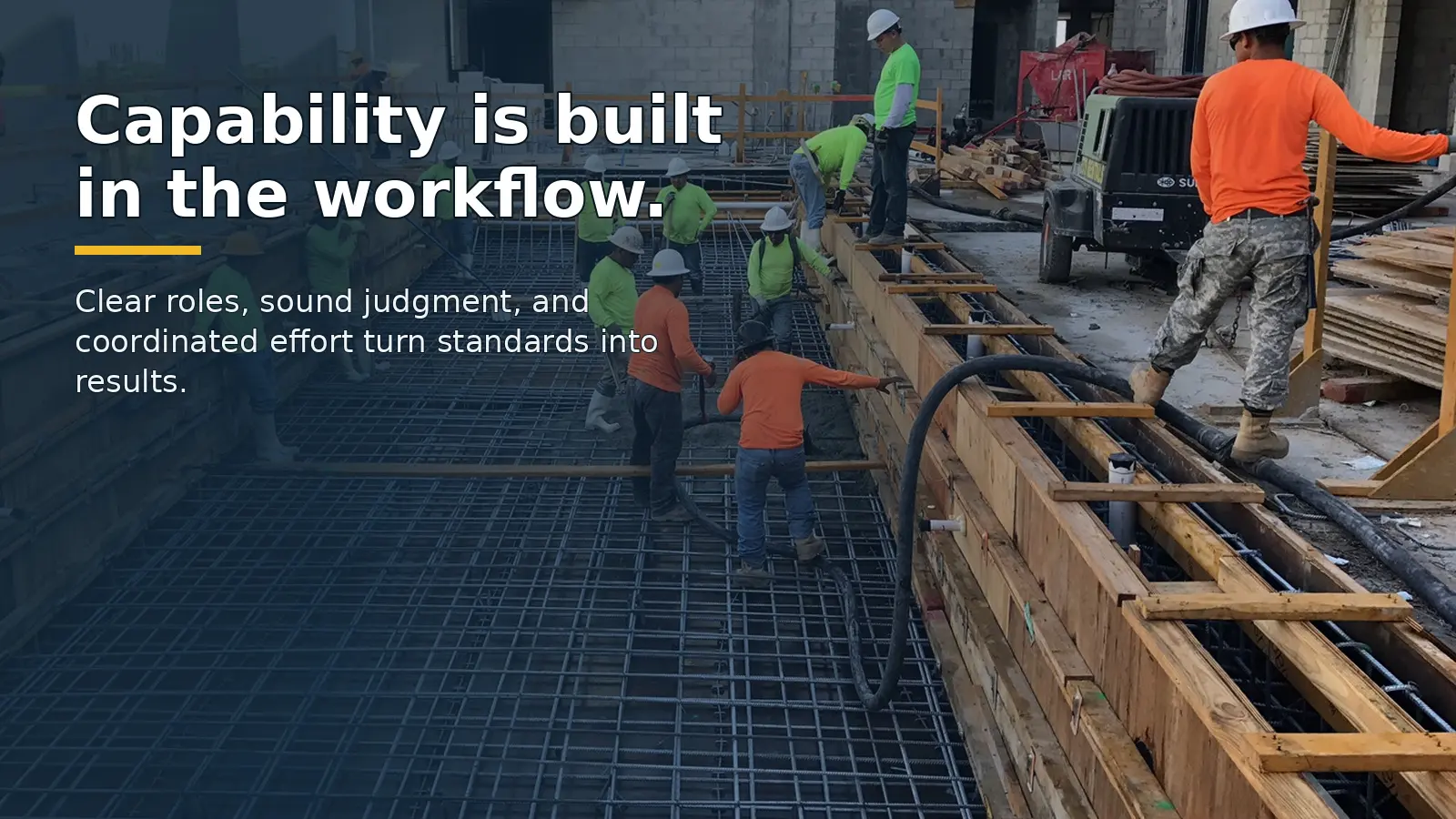
Before the visit, choose a purpose: a morning launch, route handoff, complex repair, estimate-to-production transition, recurring complaint, or heat-exposed task. Ask the crew leader what would make the observation useful rather than disruptive.
During the visit, observe the whole work cycle. Notice the information available at the beginning and the changes that arrive later. Ask the employee what creates rework, delay, risk, or avoidable customer friction. Ask what leadership could stop doing. Do not turn every answer into a promise.
After the visit, classify what you learned: safety, staffing, equipment, materials, information quality, route design, training, authority, customer communication, or individual performance. Resolve what can be resolved quickly. Escalate what cannot. Then return with an answer.
Over time, track operational conditions rather than personalities: issue-closure time, recurring missing-material events, avoidable rework, near-miss reporting quality, customer escalations, absenteeism, and turnover patterns. Do not announce causal victories too early. Pilot the practice, learn from it, and measure honestly. Evidence supports learning about conditions and improving controls; it does not establish that a work-along by itself causes trust, retention, safety, or productivity gains.[13]
From The Dr. Claude Kershner Show
Managing and Leading Trade Work
A short companion perspective on the dignity, skill, and leadership required to lead a service business close to the work.
The leadership advantage is presence with purpose
The future does not belong to leaders who reject AI. It belongs to leaders who use technology to remove friction while becoming more—not less—present in the human system that produces value.
The office, planning, and data matter; automation can make all three better. But no dashboard can fully convey the force of the sun on a long afternoon, the tension in a customer interaction, the missing part that derails a job, the judgment required to decide whether conditions are safe, or the quiet pride of a professional who solves a problem well.
Leaders do not have to become the strongest laborer or the most advanced technician to lead well. They do have to earn the right to set expectations by understanding the environment in which those expectations are met.
Put on the boots. Go where the work happens. Listen with enough humility to learn. Then come back and remove something that makes good work harder than it needs to be.
That is not symbolic leadership. It is operational leadership with a human face.
Recommended reading
Continue the work
Field-fluent leadership begins with seeing people, standards, and operating conditions clearly. If this argument meets you where you are, choose the next useful step:
- Read Deemed Essential for a deeper exploration of dignity, purpose, and the people who carry essential work.
- Join the conversation and tell us what you are working through.
- Request the 78-page Built for the Work Premium Edition guide.
Companion video
Watch: Field Fluency in Practice
Prefer to listen and watch? This companion episode brings the central ideas to life—from seeing the work as it is actually performed to pairing genuine support with clear standards.
Notes
[1] International Labour Organization, Generative AI and jobs: A refined global index of occupational exposure (2025), https://doi.org/10.54394/HETP0387. [2] World Economic Forum, Future of Jobs Report 2025, https://www.weforum.org/publications/the-future-of-jobs-report-2025/digest/. [3] OSHA, Heat—Overview: Working in Outdoor and Indoor Heat Environments, https://www.osha.gov/heat-exposure. [4] CDC/NIOSH, Heat Stress and Workers, https://www.cdc.gov/niosh/heat-stress/about/index.html. [5] E. Demerouti et al., “The Job Demands–Resources Model of Burnout” (2001), https://doi.org/10.1037/0021-9010.86.3.499; S. K. Parker et al., “One Hundred Years of Work Design Research” (2017), https://doi.org/10.1037/apl0000106; S. Sonnentag & C. Fritz, “The Recovery Experience Questionnaire” (2007), https://doi.org/10.1037/1076-8998.12.3.204. [6] C. R. Gerstner & D. V. Day, “Meta-Analytic Review of Leader–Member Exchange Theory” (1997), https://doi.org/10.1037/0021-9010.82.6.827; J. A. Colquitt et al., “Justice at the Millennium” (2001), https://doi.org/10.1037/0021-9010.86.3.425. [7] J. A. Colquitt et al., “Justice at the Millennium” (2001), https://doi.org/10.1037/0021-9010.86.3.425; D. D. Frink & R. J. Klimoski, “Advancing Accountability Theory and Practice” (2004), https://doi.org/10.1016/j.hrmr.2004.02.001. [8] Douglas McGregor, The Human Side of Enterprise (McGraw-Hill, 1960). Use as a foundational management text, not contemporary causal evidence. [9] J. A. Colquitt et al., “Justice at the Millennium” (2001), https://doi.org/10.1037/0021-9010.86.3.425. [10] A. Edmondson, “Psychological Safety and Learning Behavior in Work Teams” (1999), https://doi.org/10.2307/2666999; M. L. Frazier et al., “Psychological Safety: A Meta-Analytic Review and Extension” (2017), https://doi.org/10.1111/peps.12183. [11] C. Dormann & D. Zapf, “Customer-Related Social Stressors and Burnout” (2004), https://doi.org/10.1037/1076-8998.9.1.61. [12] A. A. Grandey, “Emotion Regulation in the Workplace” (2000), https://doi.org/10.1037/1076-8998.5.1.95. [13] S. K. Parker et al. (2017); J. D. Nahrgang et al., “Safety at Work” (2011), https://doi.org/10.1037/a0021484; the evidence brief’s intervention-limit statement. [14] EEOC, “Enforcement Guidance on Reasonable Accommodation and Undue Hardship under the ADA” (2002), https://www.eeoc.gov/laws/guidance/enforcement-guidance-reasonable-accommodation-and-undue-hardship-under-ada; 29 C.F.R. § 1630.2(r), https://www.ecfr.gov/current/title-29/subtitle-B/chapter-XIV/part-1630/section-1630.2. High-level U.S. guidance only; obtain qualified advice for case-specific application. [Morgan] Jacob Morgan, “The Art of Human Prompting: Why the Most Important Questions in an AI-Powered Organization Aren’t Asked to Machines” (April 15, 2026), Great Leadership, https://greatleadership.substack.com/p/human-prompting-ai-leadership-future-work. Morgan’s definition and machine/people contrast appear in the public opening; the remainder is paywalled.
Free · 5 minutes · The Kershner Lab
How effective is your leadership, really?
Take the free five-minute Leadership Effectiveness self-assessment from The Kershner Lab and get a personalized profile of your strengths and growth areas.
Take the Leadership Effectiveness assessment → See all assessments