
Organizational Design Is Personal: What Managers, Students, and Entrepreneurs Need to Learn Now
Organizational Design Is Personal: What Managers, Students, and Entrepreneurs Need to Learn Now
Most people encounter organizational design as a chart: boxes, titles, reporting lines, and a few arrows. That is part of it—but only part.
Organizational design is the practical answer to a much larger question: How will people work together to accomplish an important outcome? It determines how work is divided, who has authority to decide, how teams coordinate, where information travels, and who is accountable when something goes wrong.
That makes organizational design personal. It shapes whether you can make a customer decision without waiting three weeks, whether you know who owns a handoff, whether a good idea reaches someone with authority, and whether new technology helps you do better work or simply creates faster confusion.
For managers and leaders, the lesson is not to memorize one “best” structure. For students and professionals, it is not to wait until you have a senior title to understand how organizations work. For entrepreneurs, it is not to assume a small team can operate without design.
The better question is: How can I help create clarity, judgment, coordination, and responsible action around the work in front of me?
FROM THE DR. CLAUDE KERSHNER SHOW
See the complete Organizational Design lesson
Watch the full video for a practical walk-through of people, structure, alignment, and responsible AI in the work system.
First, understand the system—not just your job
A standard management text describes six building blocks of organizing: designing jobs, grouping jobs, establishing reporting relationships, distributing authority, coordinating activities, and differentiating positions. That is a useful starting point because it explains why a structure is more than a hierarchy.
When work feels slow or frustrating, leaders often blame effort: “People need to communicate better.” Sometimes they do. But the deeper issue may be the design of the work itself:
- A customer problem may move across too many departments.
- The person closest to the information may lack authority to act.
- Two teams may be measured on goals that conflict.
- A manager may have too many direct reports with too much variation in their work.
- A new tool may generate output faster than the organization can review, approve, or use it.
This is systems thinking at a practical level. Before trying to fix a person, ask what the system is asking that person to do.
Practical recommendation: Map one recurring outcome you care about. It might be resolving a customer issue, producing a proposal, onboarding an employee, completing a class project, or delivering a service. Write down:
- the outcome and how quality will be recognized;
- the people or teams involved;
- the decisions that slow the work;
- the handoffs where information is lost; and
- the point at which someone can correct an error.
You do not need an expensive transformation program to learn from this exercise. You need curiosity and enough honesty to see where the work actually travels.
Clarify outcomes, authority, and accountability
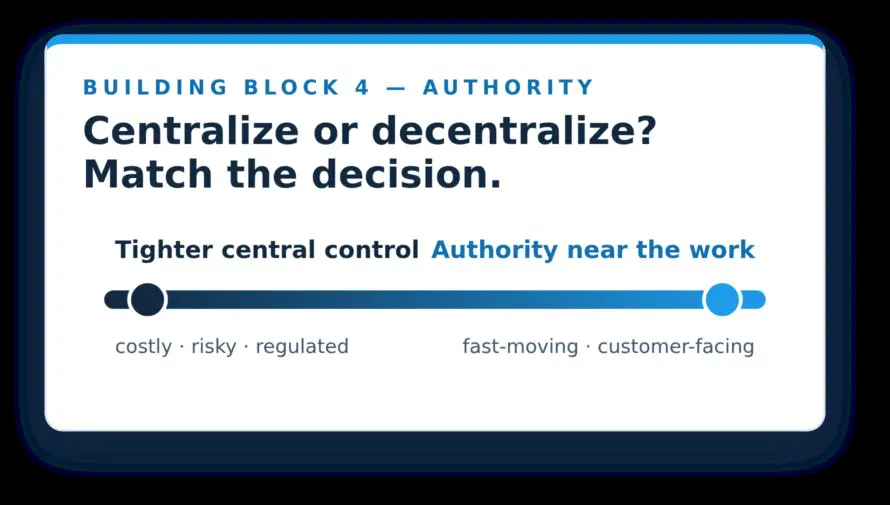
A healthy organization does not give every person unlimited autonomy. It makes authority visible and proportionate to the decision.
Management research distinguishes authority—legitimized power to act—from accountability—the obligation to accomplish the assigned work. Delegation can move work and some decision power closer to the people with relevant information, but it does not erase managerial accountability.
That distinction matters for the individual manager. “I delegated it” is not a complete operating system. People need to know:
- What outcome am I responsible for?
- Which decisions can I make independently?
- What financial, customer, legal, or quality threshold requires escalation?
- Who must be consulted before I act?
- What evidence should support the decision?
- Who communicates the result and learns from it?
A useful personal practice is a one-page decision card for a recurring decision. State the decision, the accountable owner, the person authorized to act, the evidence required, the limits, and the escalation trigger. This is more valuable than a generic RACI chart when the work is complex, because it converts abstract roles into usable choices.
Evidence, not mythology: Decentralization can improve responsiveness when decision rights are aligned with relevant knowledge. It can also create inconsistency, duplicated work, or unmanaged risk when boundaries are unclear. The goal is not maximum freedom; it is clear freedom within clear guardrails.
Build judgment, not just productivity
Artificial intelligence makes this lesson more urgent. AI can help people draft, summarize, search, classify, and generate options quickly. In some settings, research has found meaningful task-level productivity gains, including gains for less-experienced workers. But other research finds that results vary sharply by task: a tool can be helpful inside its capability frontier and plausibly wrong just outside it.
The implication for individual leaders is straightforward: speed is not the same as judgment.
If you use AI at work or in school, build five habits:
- Frame the problem before prompting. Know the decision or outcome you are trying to improve.
- Check the source and the context. Do not mistake fluent language for verified information.
- Protect information. Use only approved tools and follow your organization’s rules for confidential, customer, employee, health, financial, or regulated data.
- Keep a human owner for consequential decisions. A model can recommend; a person with authority must decide.
- Learn from exceptions. When an output fails, ask whether the problem was the prompt, the data, the process, the control, or the judgment applied to it.
The National Institute of Standards and Technology (NIST) frames responsible AI risk management as governing, mapping, measuring, and managing risk. You do not need to be a data scientist to apply that logic. As a manager, you can ask: Who owns this use case? What data is involved? How will we test it? What would make us pause it? Who can override it?
That is leadership. It is also a way to make sure technology strengthens, rather than weakens, accountability.

Coordinate across boundaries
Organizations rely on specialization because no one person can master every task. Specialization can increase proficiency and reduce training time. But when jobs become too narrow, people can lose sight of the customer, the whole outcome, and one another.
The answer is not to abolish expertise. It is to create reliable coordination.
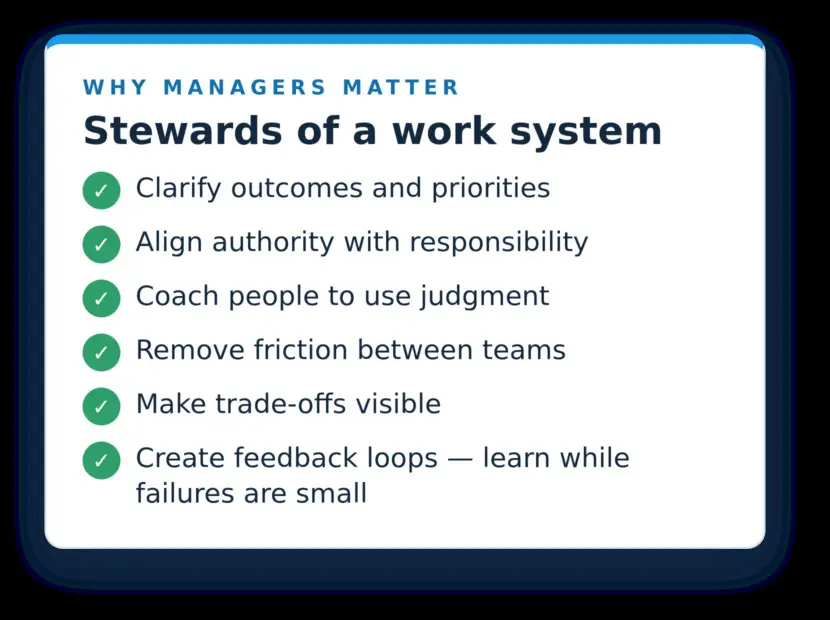
For an individual manager, that can mean:
- agreeing on a shared customer or operating outcome with adjacent teams;
- defining what a “complete” handoff includes;
- setting a regular, short review of exceptions rather than holding status meetings by habit;
- using a visible work queue or decision log;
- inviting the people who perform the work to identify friction and propose changes; and
- giving feedback on quality and impact, not just volume.
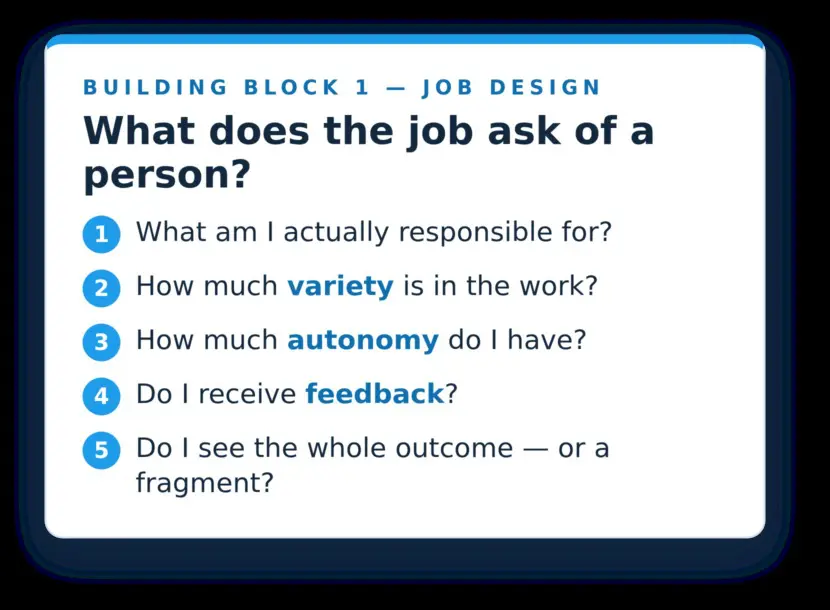
A course framework on job design highlights skill variety, task identity, task significance, autonomy, and feedback. These are not soft extras. They are clues about whether people can see meaningful work, exercise judgment, and learn from results. A team that only receives fragmented tasks and delayed feedback will struggle to improve—even if its members are talented.
For students and early-career professionals: start practicing coordination now. In group projects, do not merely divide slides. Define the outcome, decide who owns the final integration, agree on evidence standards, set a check-in point, and make the handoff explicit. Those are organizational-design skills in miniature.
Create entrepreneurial action—with safeguards
Entrepreneurship is not limited to founding a company. It can also mean noticing an unmet need, forming a testable hypothesis, gathering evidence, and mobilizing people to improve a product, service, or process.
Research on entrepreneurial orientation finds a positive association between innovativeness, proactiveness, calibrated risk-taking, and performance across studies. That is an encouraging relationship—not proof that every new idea will succeed or that risk-taking alone creates results.
The practical lesson is to create a bounded experiment, not a grand claim.
Try this sequence:
- Identify a customer, learner, employee, or operational problem.
- State a small hypothesis: “If we change this step, we expect this outcome.”
- Define a 30- to 60-day test, a modest resource limit, and a responsible owner.
- Decide in advance what evidence would mean scale, redesign, or stop.
- Protect customers, colleagues, data, safety, and brand reputation throughout the test.
- Share what you learned, including what did not work.
Entrepreneurial action becomes more credible when it has a route to a real decision. Managers can help by giving people time, sponsorship, criteria, and a dignified way to stop a weak idea. Entrepreneurs can help by resisting the temptation to treat speed as a substitute for unit economics, customer evidence, or compliance.

Design your ripple effect
Your role may be one box on a chart, but your behavior shapes the system around you.
When you clarify a decision, you reduce uncertainty for someone else. When you document a handoff, you make future coordination easier. When you verify an AI-generated claim, you protect a customer and model good judgment. When you invite a frontline colleague into process improvement, you increase the organization’s capacity to learn. When you turn an idea into a measured experiment, you make entrepreneurship practical rather than theatrical.
This is the personal side of organizational design: not controlling every part of the system, but improving the part you can influence while seeing its connection to the whole.
The organizations that adapt well in the next few years will not necessarily be the flattest, the most automated, or the loudest about innovation. They are more likely to be the ones in which people understand the outcome, know who can decide, coordinate across boundaries, test thoughtfully, and retain human accountability where it matters.
Start there. Learn the system. Clarify the work. Strengthen judgment. Create room for responsible action.

Selected sources
- Parker, S. K., Morgeson, F. P., & Johns, G. (2017). Journal of Applied Psychology, 102(3), 403–420..
- Brynjolfsson, E., Li, D., & Raymond, L. R. (2023). Generative AI at Work. NBER Working Paper 31161.
- National Institute of Standards and Technology. (2023). AI Risk Management Framework 1.0.
- Rauch, A., Wiklund, J., Lumpkin, G. T., & Frese, M. (2009). Entrepreneurial orientation and business performance.
Free · 5 minutes · The Kershner Lab
How ready are you to lead in the AI era?
A free five-minute self-assessment from The Kershner Lab scores your AI literacy, judgment, adaptability, and people leadership, with personalized strengths and next steps.
Take the AI-Era Leadership Readiness assessment → See all assessments