
The Other Side of the Ledger: An Honest Audit of What College Costs — and What It Returns
It has become fashionable — cool, even — to announce that you didn’t go to college. To ask “who needs a degree?” To repost the tuition meme, shake your head at what universities charge, and wonder aloud what they’re doing with all that money.
Some of that criticism is earnest, and some of it lands. I’m going to give it a fair hearing in a moment — the real numbers, not a caricature. But I want to name the thing that confuses me first: much of this content comes from businesspeople. Investors. Operators. People who would never evaluate an acquisition, a machine, or a hire by reading only the cost column.
So let’s hold ourselves to our own standard. An audit examines both sides of the ledger. This essay is that audit.
Where my own ledger starts
Let me put my cards on the table, because this isn’t abstract for me.
My learning journey began in my sophomore year of college. I was sitting on campus, in a personality psychology course, reading the textbook — and something caught. I remember the day. I remember exactly what I was reading. Until that moment I’d had very little interest in reading textbooks at all. After it, I never stopped. It has been an unbelievable journey since — one course, one book, one professor’s syllabus set a trajectory I’m still riding today.
Later, I paid for my entire graduate education myself, out of pocket, while working full-time. So when I tell you the cost is real, I’m not theorizing — I wrote the checks. And I’d write every one of them again.
Keep that story in mind. It’s data too, and we’ll come back to what it implies.
The critics’ case — steelmanned, with their best evidence
If I’m going to argue against the cost conversation, I owe it the strongest version of itself. Here it is:
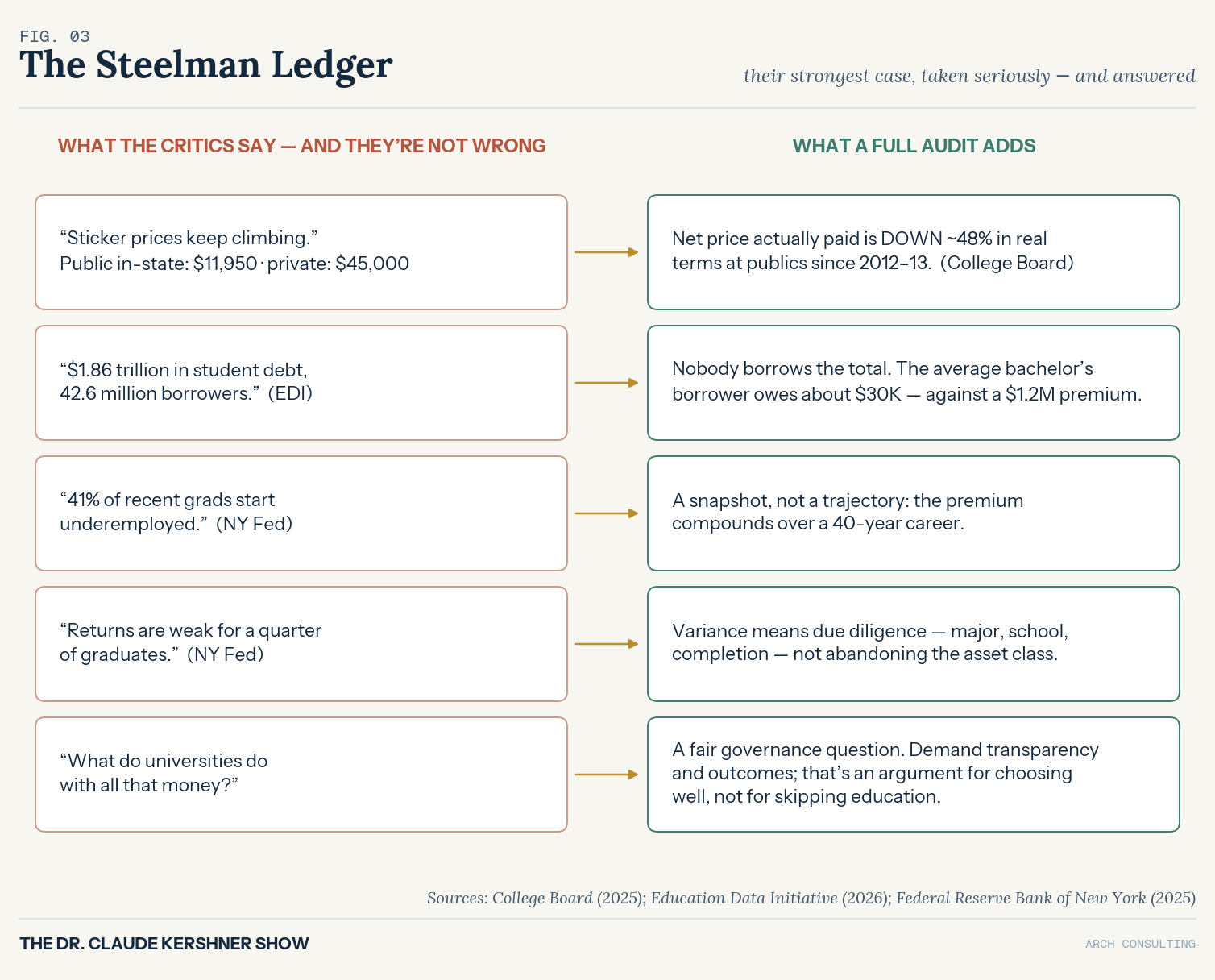
- Sticker prices are high and rising. Published tuition and fees for 2025–26 run about $11,950 in-state at public four-year institutions and about $45,000 at private nonprofits (College Board, Trends in College Pricing 2025). Those are real numbers on real award letters.
- The debt is enormous in aggregate. Americans hold roughly $1.86 trillion in student loan debt across about 42.6 million borrowers (Education Data Initiative). Some borrowers — especially graduate borrowers — carry six figures.
- The early job market can be rough. The New York Fed’s tracker showed underemployment for recent graduates spiking above 41% in 2025 — four in ten new grads working jobs that didn’t require their degree.
- The return isn’t universal. The same NY Fed economists who calculate a 12.5% return for the median graduate note that returns are meaningfully lower for perhaps a quarter of graduates — and that students who start but don’t finish pay much of the cost for far less of the benefit.
- Governance questions are fair. “What are universities doing with all this money?” is a legitimate question for any institution that takes in billions. Cost discipline, administrative growth, and outcome transparency deserve scrutiny.
Credit where credit is due: every one of those points is real, and the pressure they create is healthy. Institutions should feel it.
Now — here’s why none of it wins the argument.
Rebuttal one: the critics are auditing the wrong price
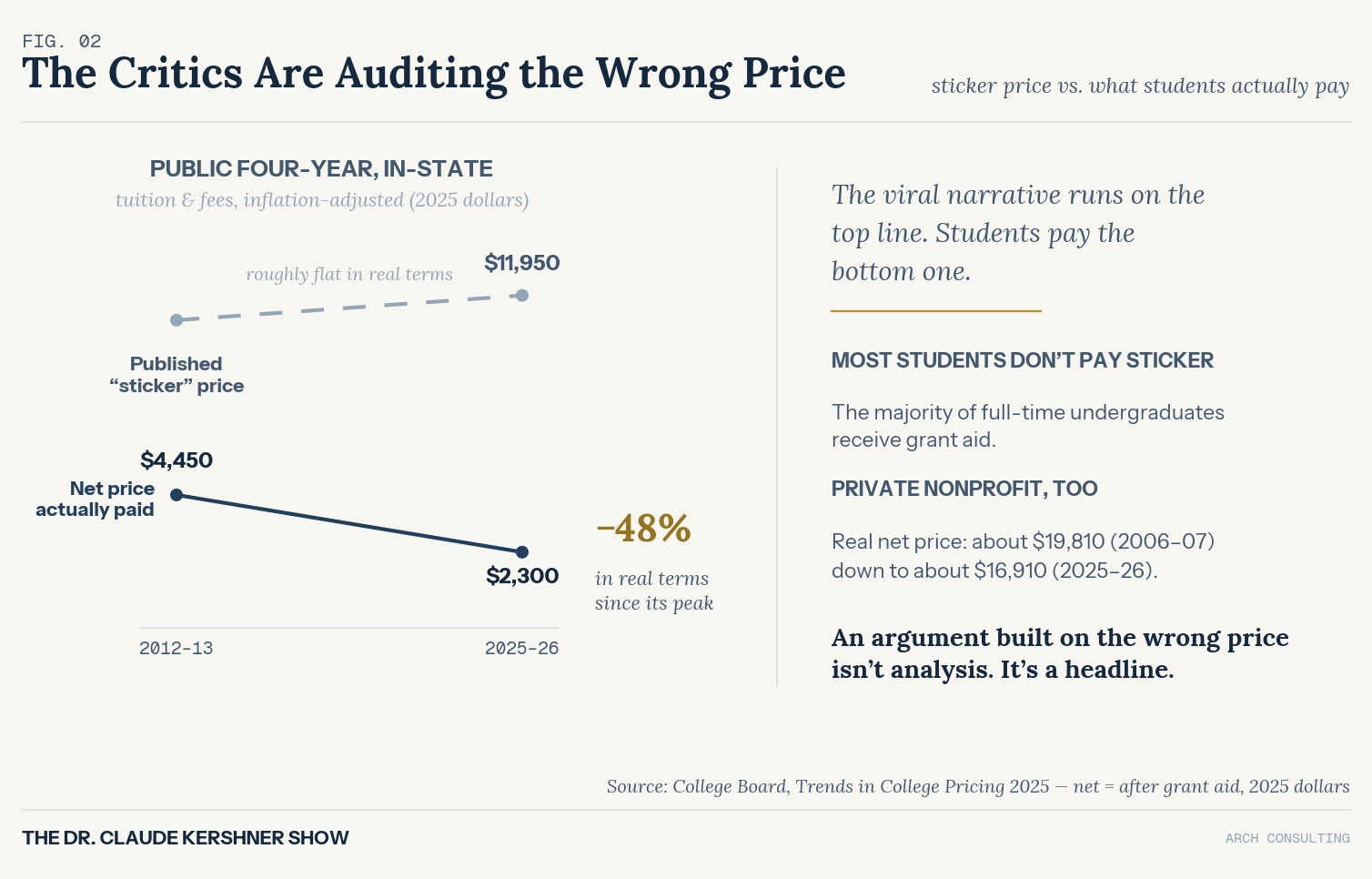
The cost conversation runs on sticker prices. Almost nobody pays sticker.
Once grant aid is counted, the average net tuition and fees an in-state student actually pays at a public four-year institution has fallen — from a peak of about $4,450 in 2012–13 to roughly $2,300 in 2025–26, in inflation-adjusted dollars. Net price at private nonprofits has declined in real terms too, from about $19,810 in 2006–07 to about $16,910 today (College Board). The majority of full-time undergraduates receive grant aid.
Read that again: adjusted for inflation, the real tuition price most public-university students pay has dropped by nearly half over the past decade — during the exact years the “colleges cost more than ever” narrative went viral. An argument built on the wrong price isn’t analysis. It’s a headline.
Rebuttal two: totals are not prices
“$1.86 trillion” is a rhetorical device, not a decision variable. Nobody borrows the national total. The relevant unit is one student, one balance: the average bachelor’s graduate who borrows finishes with roughly $30,000 of debt (Education Data Initiative).
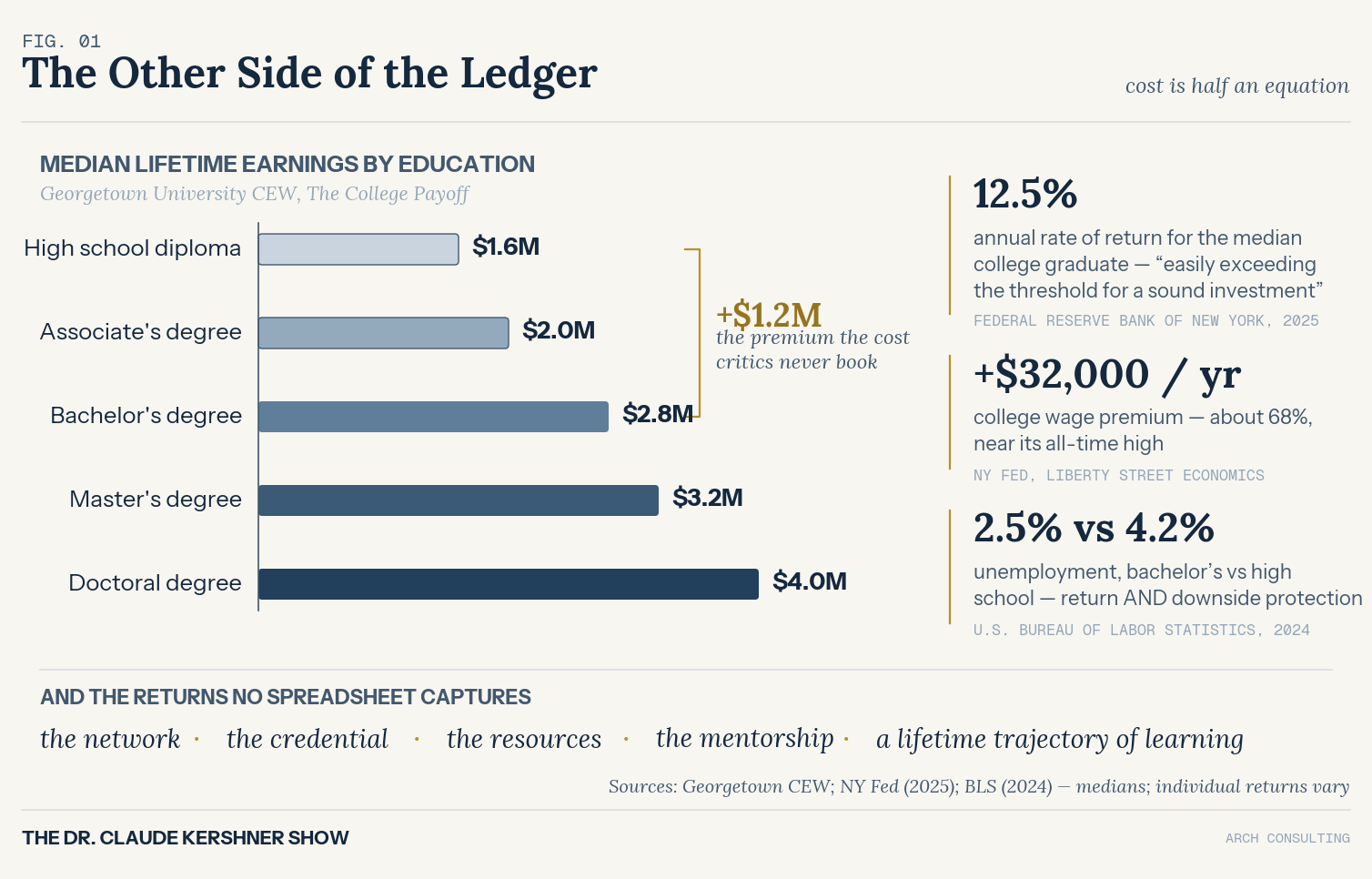
Now do what any operator does — put the liability next to the asset it financed. Thirty thousand dollars, a car-loan-sized balance, set against a median $1.2 million lifetime earnings premium (Georgetown CEW), a 12.5% annual return (NY Fed), and an unemployment rate roughly half that of high-school-only workers (BLS, 2024: 2.5% vs 4.2%). We finance cars that lose value the day they leave the lot and call it normal. A degree is the rare financed asset that appreciates — and somehow it’s the scandal?
Rebuttal three: a snapshot is not a trajectory
Yes, 41% early underemployment is a hard first chapter. But it is the first chapter. Underemployment falls as graduates settle into careers, and the earnings premium compounds over a forty-year working life — that’s precisely how the median $1.2 million gap accumulates. Judging a degree by a graduate’s first job is like judging an orchard by its first season.
Rebuttal four: variance argues for diligence, not abandonment
The quarter-of-graduates caveat is the critics’ best analytical point, and I accept it — as an investor would. Some majors, some institutions, and non-completion produce weak returns. In every other asset class we know exactly what that means: do due diligence and structure the deal well. No one liquidates their entire portfolio because some stocks underperform.
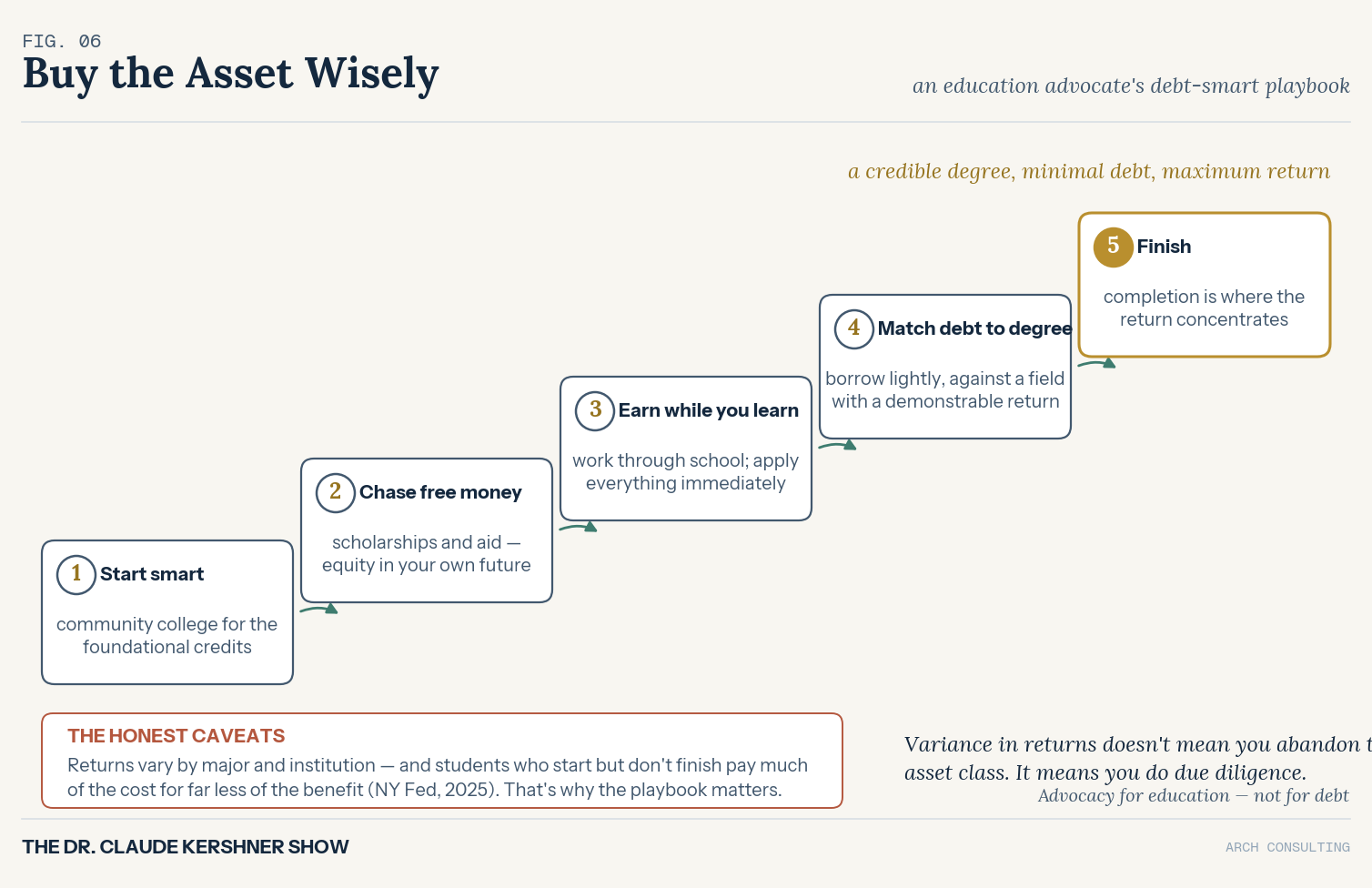
So here is my playbook — and I say this as an advocate for education, not for debt: start at community college when it makes sense; chase scholarships and aid relentlessly; earn while you learn and apply everything immediately; match any borrowing to a field with a demonstrable return; and finish, because completion is where the return concentrates. A debt-smart path to a credible institution isn’t a compromise of my argument. It is my argument.
Rebuttal five: “where does the money go?” is a governance question, not a verdict
Ask it! Boards, legislatures, accreditors, and — most powerfully — enrolling families should demand outcome transparency and cost discipline. But notice the logical structure: waste inside some institutions is an argument for choosing institutions well and holding them accountable. It is not an argument that education itself lacks value, any more than a badly run company proves markets don’t work.
The false binary the critics smuggle in
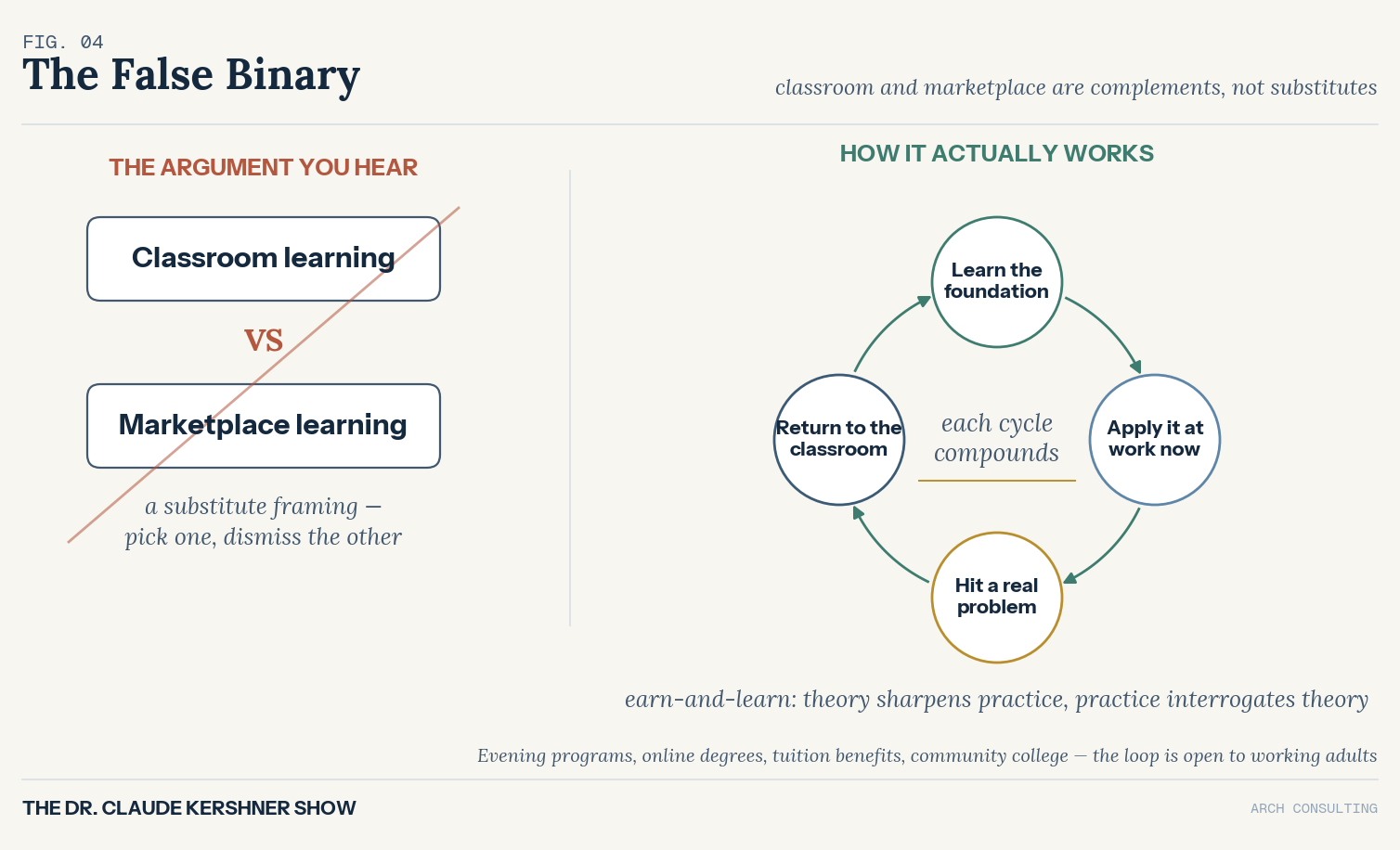
Beneath the cost talk usually sits an unstated premise: real learning happens in the marketplace, so the classroom is dispensable. There’s credence in half of that — I’ve learned things on job sites and in negotiations that no lecture could teach. But classroom and marketplace are complements, not substitutes. The most powerful model I know is the earn-and-learn loop: learn the foundation, apply it at work immediately, hit a real problem, bring it back to the classroom. Theory sharpens practice; practice interrogates theory; each cycle compounds. And that loop is more open than ever — evening programs, online degrees, employer tuition benefits, community college schedules built for working adults.
What the spreadsheet still can’t see
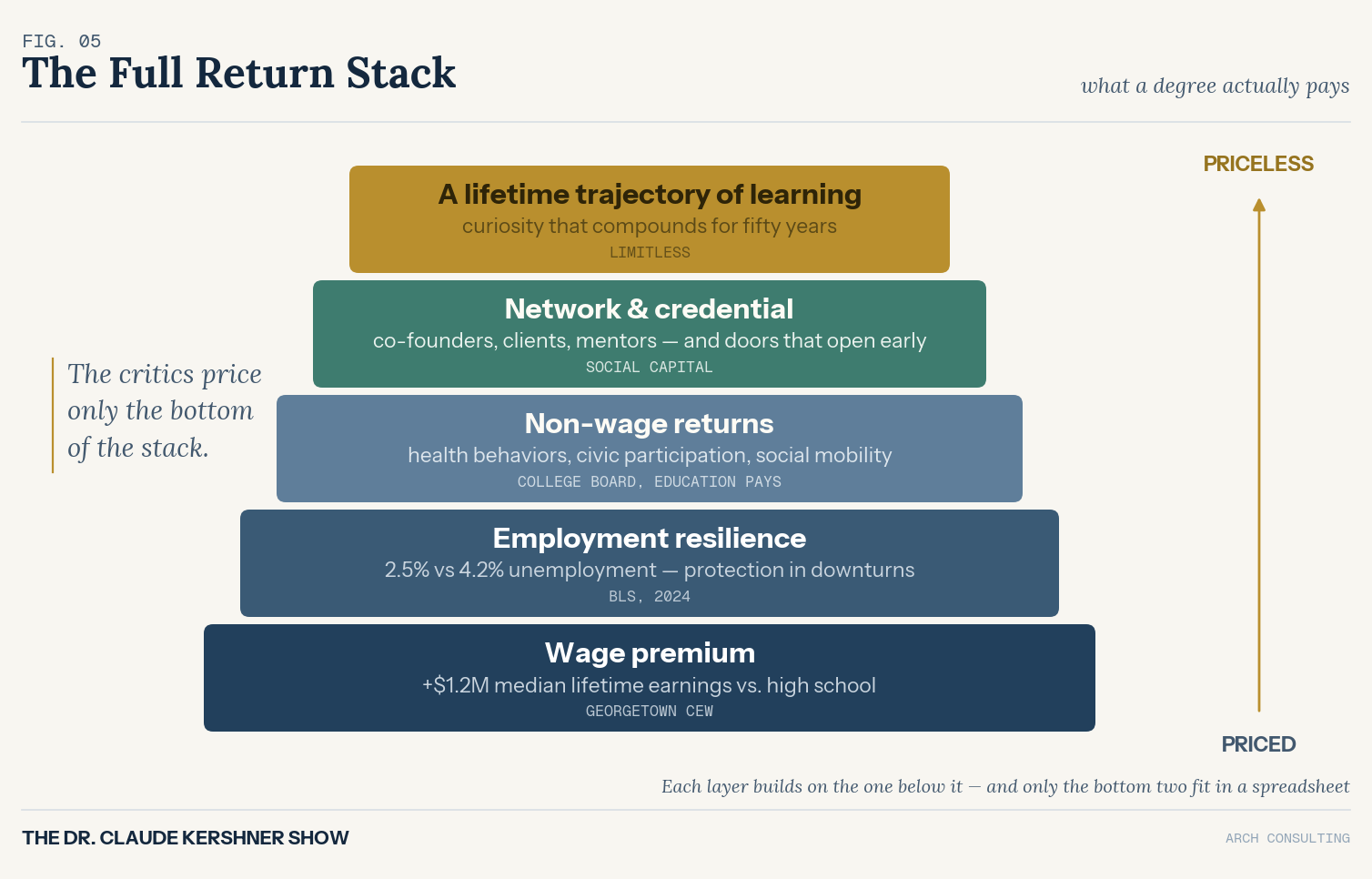
Even the $1.2 million undercounts, because it only prices wages. Stack the rest:
- The network. Count the companies founded by people who met on a campus.
- The credential. It opens doors before you’ve said a word.
- The resources. Libraries, labs, whole environments engineered for thinking.
- The catalyst. The layer I can testify to personally.
Remember my sophomore-year psychology course? Nobody could have priced that moment in advance. No ROI model had a cell for “this textbook will ignite a lifetime of learning.” Yet that single catalyst has paid returns for decades — through every business I’ve built, every class I’ve taught, every problem I’ve zoomed out on. If an institution does nothing but place one such catalyst in one student, the return is not large. It is limitless. The College Board’s Education Pays research adds the measurable echoes: better health behaviors, more civic participation, greater social mobility.
Where are the graduates? Speak up.
Which brings me to my challenge. Where are the successful businesspeople, physicians, attorneys, and engineers who can trace real parts of their success to their degrees? You sat in those classrooms. Somewhere — probably young — a catalyst got placed in your system, and you are now sitting on returns that are multiples of what you invested. Yet the loudest voices on this platform are the dismissers, and your silence gets read as agreement.
Speak up. I know you’re out there. I know many of you believe in this as much as I do. Tell the story of what your education actually returned — because clearly, something worked.
The closing entry
Audit complete. On one side: a net price that has fallen in real terms for a decade, financed — when it’s financed at all — by a car-loan-sized balance. On the other: a near-record earnings premium, a 12.5% annual return, half the unemployment risk, measurable health and civic dividends, and at least one line item no accountant can price — the day a course, a book, or a professor sets a person on a lifetime trajectory of learning.
What better investment exists than an investment in your own mind? There are very few things in this world more worthwhile.
So the next time someone critiques the cost of education, ask them to quantify the value in the same breath. Anything less isn’t analysis — it’s just complaining.
What did education return for you — in dollars, or in something you still can’t put a price on?
Sources
- College Board, Trends in College Pricing 2025
- Georgetown University Center on Education and the Workforce, The College Payoff
- Federal Reserve Bank of New York, Is College Still Worth It? and The Labor Market for Recent College Graduates
- U.S. Bureau of Labor Statistics, Education Pays, 2024
- Education Data Initiative, Student Loan Debt Statistics
- College Board, Education Pays
Figures are medians and national averages; individual results vary by field of study, institution, and completion. Net prices are inflation-adjusted (2025 dollars). Illustrations are original Dr. Claude Kershner Show graphics.