
The AI-Native Field-Service Organization: Better Coordination, Better Service
A customer calls because a pool pump is making a new noise. The office has the property record, but not the technician’s last voice note. The technician has photos, but not the warranty detail. Someone remembers that the customer has a special access instruction, but it is not where the dispatcher needs it. By the time the information is assembled, the customer has called twice, the technician is heading out with partial context, and the office is chasing documentation after the fact.
That is not primarily a software problem. It is a coordination problem.
How owner-led field-service organizations can use one governed workflow to reduce coordination friction—without giving up human judgment.
Ep. 108: The AI-Native Field-Service Organization
Most field-service companies already have valuable systems: scheduling, work orders, customer history, payments, texts, technician mobile tools, accounting, and CRM. Those systems matter. They create records, structure work, and make a great deal of modern service possible.
But software is not the same thing as an operating model.
The next advantage for owner-led field-service organizations may be an AI-native operating layer: a company-specific capability that connects field evidence, company knowledge, and existing systems of record so that accountable people can make faster, better-informed decisions.
This is not a case for an autonomous service company. It is a case for a more capable one.
The cost owners often cannot see clearly
Owners can find the subscription invoice. The harder number to see is the cost that lives around it:
- duplicate entry and re-keying
- incomplete photos, notes, readings, and closeout documentation
- missed handoffs between the field and office
- slow estimates, invoices, and customer updates
- callbacks, avoidable repeat visits, and disputed bills
- training friction and workarounds
- the loss of practical knowledge when the best technician or dispatcher is unavailable
That invisible ledger is where a service organization either gains momentum or accumulates friction.
The right question is not, “Which AI tool should we buy?” It is: Where does information wait, get lost, or have to be reconstructed before a responsible person can act?
A lesson from field-service operations
At Reef Tropical Pool & Lawn, we worked on versions of this problem before the current AI conversation. We built dispatch and field-service capabilities around route and service data, water-use tracking, chemical logs, automated customer communication, and job-profitability visibility. We also explored smart-meter information at Ocean Reef Club to identify abnormal water-use patterns—a line of thinking that became part of the Aqua Alert and My Water IQ concept.
The lesson was simple: a signal is not a service.
A water-use anomaly, a technician photo, or an equipment reading has no customer value merely because it exists. It becomes valuable when the organization can connect it to the property, service history, customer context, approved procedures, and the appropriate next action.
That means moving from:
signal → context → accountable review → customer choice → approved action → documented learning
Modern AI can help with retrieval, drafting, structuring, and exception detection when the underlying data is usable and people remain accountable for consequential decisions. It does not eliminate the need for judgment. It can make good judgment easier to apply at the right moment.
What an AI-native operating layer actually does
An AI-native field-service organization does not throw away its existing platform. Its scheduling, CRM, work-order, accounting, and payment systems can remain the systems of record.
The new layer sits around those tools and helps the organization use its own knowledge more effectively.
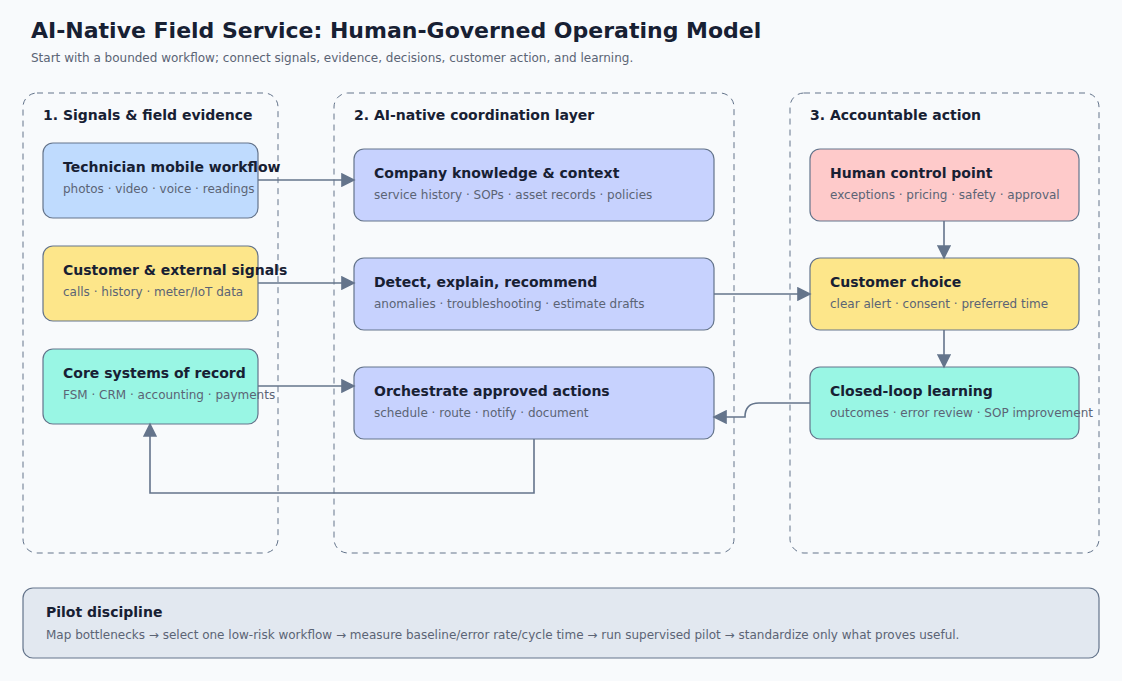
Consider one bounded workflow. A technician completes a visit and captures a photo, brief video, voice note, equipment reading, and observation. The operating layer combines that evidence with the work order, service history, equipment information, approved company procedures, warranty rules, and customer preferences.
It can then prepare a structured closeout packet, identify missing information, flag an exception, and draft a clear customer explanation or an internal recommendation.
A dispatcher, manager, or technical lead reviews what matters. The customer receives a branded, understandable update and an approved option. If the customer authorizes work, the team carries the right context into dispatch, completion, invoicing, and the next service interaction.
The goal is not to let a model make a promise to a customer, set a price, approve a payment, or decide a safety issue. The goal is to remove avoidable administrative friction before the accountable human makes the decision.
The field stays human. The office becomes more intelligent.
Why this matters now
The capability is becoming more accessible. Stanford’s 2025 AI Index reported that the cost of inference for a system at GPT-3.5-level performance fell from approximately $20 to $0.07 per million tokens between November 2022 and October 2024—a decline of more than 280-fold.[1]
That does not make implementation free, and it does not promise ROI. Integration, data cleanup, evaluation, security, governance, training, and human review still cost money and attention.
It does mean that smaller organizations can begin testing useful, narrow workflows without assuming that only the largest enterprise can participate.
The test is operational, not theatrical:
Can this workflow reduce touches, delay, rework, or frustration while improving documentation and customer service—without weakening accountability?
Local, cloud, or hybrid?
Owners should understand that not every workflow has to send company information to an outside model provider. Tools such as LM Studio, Ollama, and llama.cpp can run models on a company-controlled computer or server. For appropriate workflows, that can support private retrieval from SOPs, manuals, pricebooks, warranty rules, and internal service records.
Local capability is not automatically secure, accurate, compliant, or inexpensive. It requires hardware, access controls, backups, patching, monitoring, evaluation, and responsible maintenance. When a local system is offline, it cannot reach live systems or send messages; when it is connected, those integrations must be explicitly governed.
For many smaller firms, the practical answer will be hybrid:
- use local or private capability for selected high-volume internal work where control matters;
- use carefully governed cloud capability where stronger models or approved integrations clearly add value; and
- keep people in control of safety, pricing, payments, dispatch exceptions, customer commitments, and sensitive communications.
The design principle is not “local at all costs” or “cloud everywhere.” It is selecting the right level of capability and control for each workflow.
Start at the edge of the operation
The wrong starting point is a vague company-wide AI transformation.
The better starting point is one measurable bottleneck and one accountable team.
A.R.C.H. Consulting’s proposed AI-Native Field Service Pilot applies an Operations Boot Camp discipline:
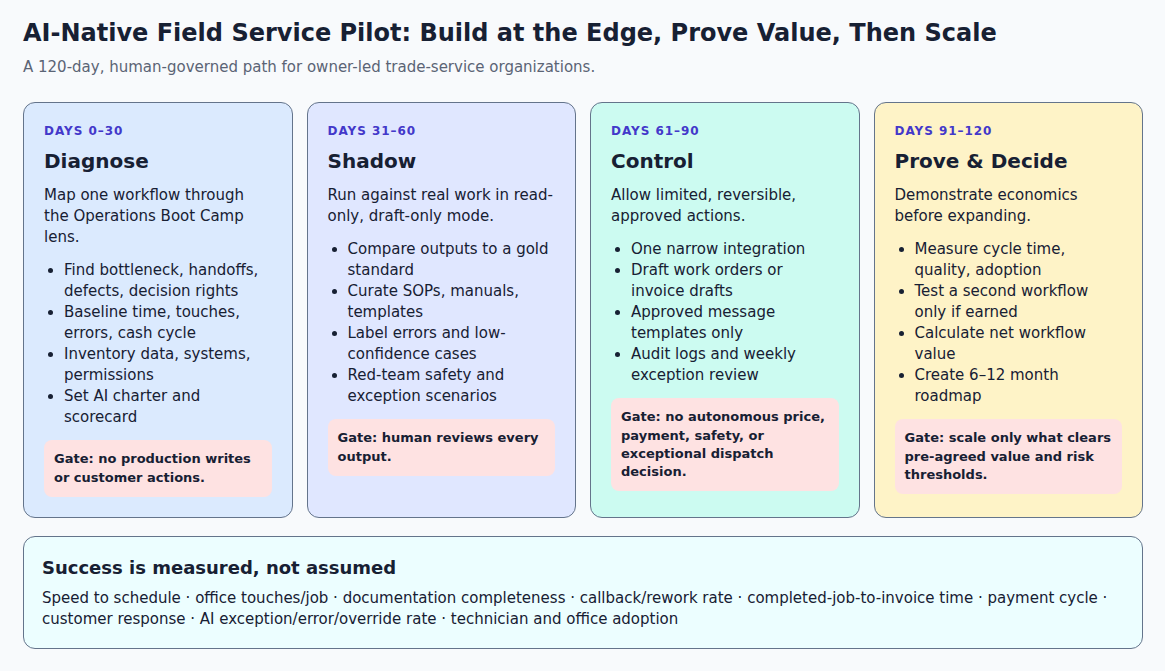
Days 1–30: Diagnose
Map one workflow. Identify where information waits, where it is re-entered, where handoffs fail, and what the baseline looks like. Establish decision rights, data access, and governance. No production writes. No automated customer messages. No autonomous dispatch, invoices, payments, or safety decisions.
Days 31–60: Shadow
Use real work in read-only or draft-only mode. Compare AI-generated summaries or closeout packets against a trusted record. Have a person review every output. Track errors, exceptions, and confidence limits.
Days 61–90: Controlled action
Allow only limited, reversible, pre-approved actions—for example, creating a draft work order or routing a reviewed closeout packet to an office queue. Keep audit logs and weekly exception review. Do not delegate pricing, payment, safety, or unusual customer commitments.
Days 91–120: Prove and decide
Measure the results against the baseline. Did closeout completeness improve? Did time-to-customer-update fall? Did dispatcher touches per job decline? Did callback, rework, error, complaint, or override rates improve or worsen? Did technicians and customers find the change useful?
Then make a scale-or-stop decision. If the workflow did not earn its place, stop. If it did, document what worked and choose the next bottleneck.
The first use case should be boringly useful
The strongest first pilot is often not a dramatic one.
A good candidate is:
field note + photo + voice evidence → structured closeout packet → office review queue
It is measurable. It improves documentation. It can reduce the burden of turning field observations into usable office context. And it does not require giving software authority over a customer’s money, safety, or trust.
A later pilot may address proactive maintenance: an abnormal signal becomes a human-reviewed customer alert, then customer authorization, then an approved dispatch path.
That is how an organization turns data into service.
The competitive advantage is learning speed
Trade-service companies do not need to become software companies. They do need to become better learners about their own operations.
The organizations that begin with a governed, measurable use case will preserve more of their people’s practical knowledge, reduce information latency, and create a better customer experience as they grow.
The future is not simply more software.
It is an organization that can see, remember, coordinate, and act more effectively—while accountable people remain firmly in charge.
Ready to explore one governed workflow?
A.R.C.H. Consulting is developing a limited AI-Native Field Service Pilot for owner-led organizations that want to test one measurable use case without disrupting core operations. We begin with one bottleneck, one accountable team, and one disciplined decision: scale only what works.
Sources
[1] Stanford Institute for Human-Centered Artificial Intelligence, The 2025 AI Index Report (2025), The 2025 AI Index Report.
Additional governance reference: NIST, Artificial Intelligence Risk Management Framework Playbook, Artificial Intelligence Risk Management Framework Playbook.
Publication note: Product availability, pricing, integrations, and implementation requirements vary by vendor and change over time. This article makes no promised-savings, autonomous-operation, or fixed-ROI claim.
For a related perspective on organizational adaptation in the AI era, read The Organizational Singularity Is Here.
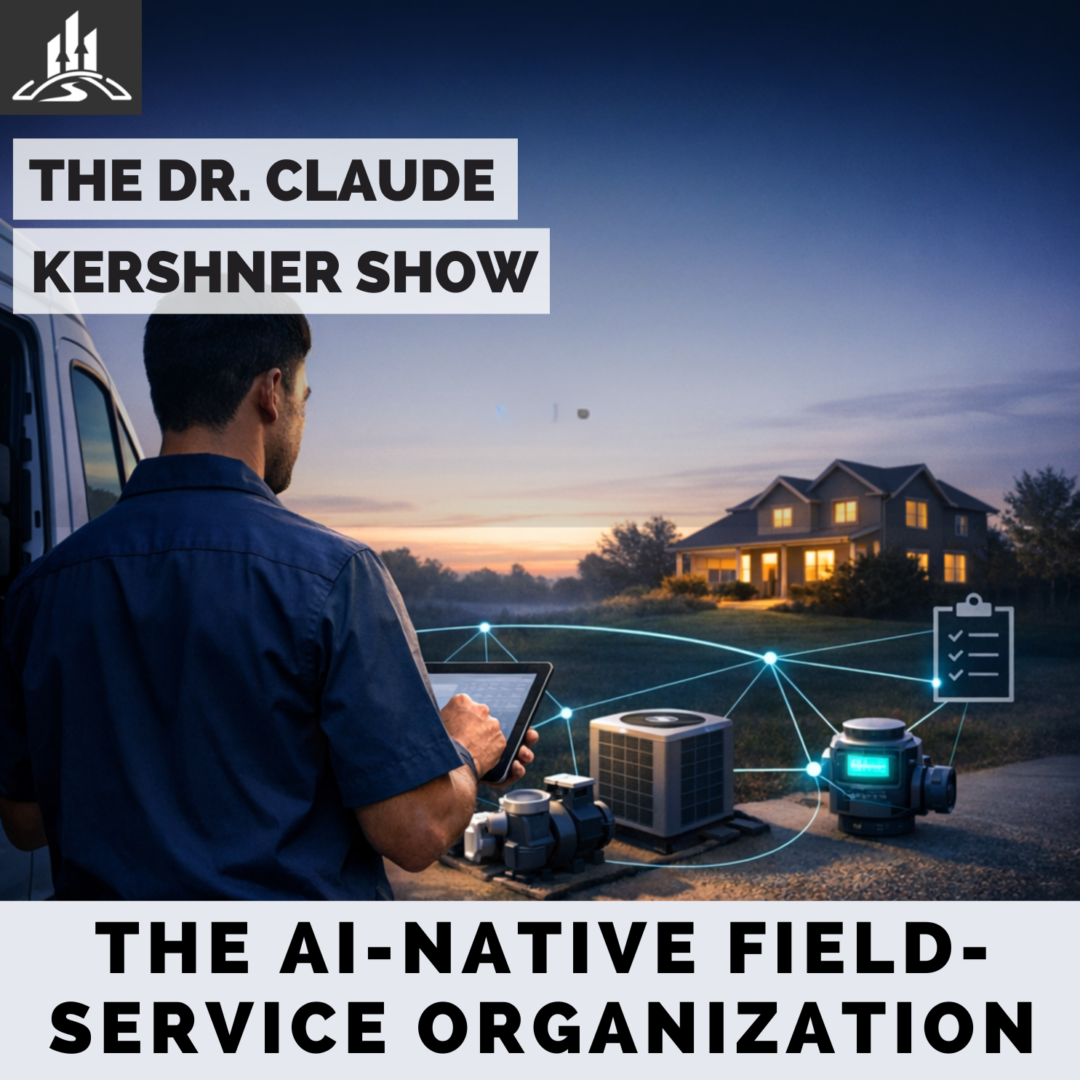
Listen to the companion episode: In Episode 108 of The Dr. Claude Kershner Show on Apple Podcasts, Dr. Claude Kershner brings this argument into a listening-first conversation for leaders building service organizations that learn without losing human judgment. You can also listen on SoundCloud or Spotify.
Continue the conversation
For adjacent work on AI, organizational adaptation, and practical field-service change, explore:
- The Organizational Singularity Is Here
- The Field Stays Human. The Office Gets Intelligent.
- The Kershner Lab
Dr. Claude B. Kershner IV, DBA is Managing Principal of A.R.C.H. Consulting and a Professor of Leadership and Management Innovation at Miami Dade College.
Free · 5 minutes · The Kershner Lab
How ready are you to lead in the AI era?
A free five-minute self-assessment from The Kershner Lab scores your AI literacy, judgment, adaptability, and people leadership, with personalized strengths and next steps.
Take the AI-Era Leadership Readiness assessment → See all assessments