The Organizational Singularity Is Here: What AI, Entrepreneurial Science, and Fifty Years of Scholarship Tell Us About What Survives
Ep. 107: The Organizational Singularity — Why Your Org Chart Is a Liability
▶ SoundCloud 🎧 Apple Podcasts
The Organizational Singularity Is Here: What AI, Entrepreneurial Science, and Fifty Years of Scholarship Tell Us About What Survives
Something shifted in my work over the past several weeks. Not incrementally. Structurally.
I have been building an AI-integrated organization from the ground up — inside my own professional practice. Not as a thought experiment for a client. Not as a pilot program someone else funded. As my daily operating reality. I have been working hands-on with AI agents, fully owned data pipelines, and interfaces like OpenClaw — and the productivity gains have reached a level I could not have comprehended six months ago. Entire coordination layers that used to consume hours have collapsed into minutes. Middle-layer decisions I used to route through multiple conversations now resolve autonomously. The experience has been clarifying in a way that pure theory never is.
I have watched coordination costs evaporate in real time. I have watched the middle layers of my own decision-making collapse — not because I eliminated them deliberately, but because they became unnecessary. That is not a productivity story. That is an architecture story.
And it has made me certain of something: the Organizational Singularity is not a future event. It is the present condition of every organization that refuses to name it.
What Ismail and Diamandis Got Right
Salim Ismail and Peter Diamandis coined the term Organizational Singularity to describe a moment analogous to the technological singularity: the point at which AI so thoroughly dissolves organizational coordination costs that the traditional rationale for the firm itself is called into question.
Ronald Coase gave us the foundational answer to “why do firms exist” in his landmark 1937 paper “The Nature of the Firm”: because coordination inside a firm is cheaper than transacting in the open market. What Ismail and Diamandis recognize — and what I now believe is empirically demonstrable in my own work — is that AI is systematically eliminating that cost advantage. The reason for the traditional hierarchy does not disappear. It shifts to something smaller, leaner, and far more purposeful.
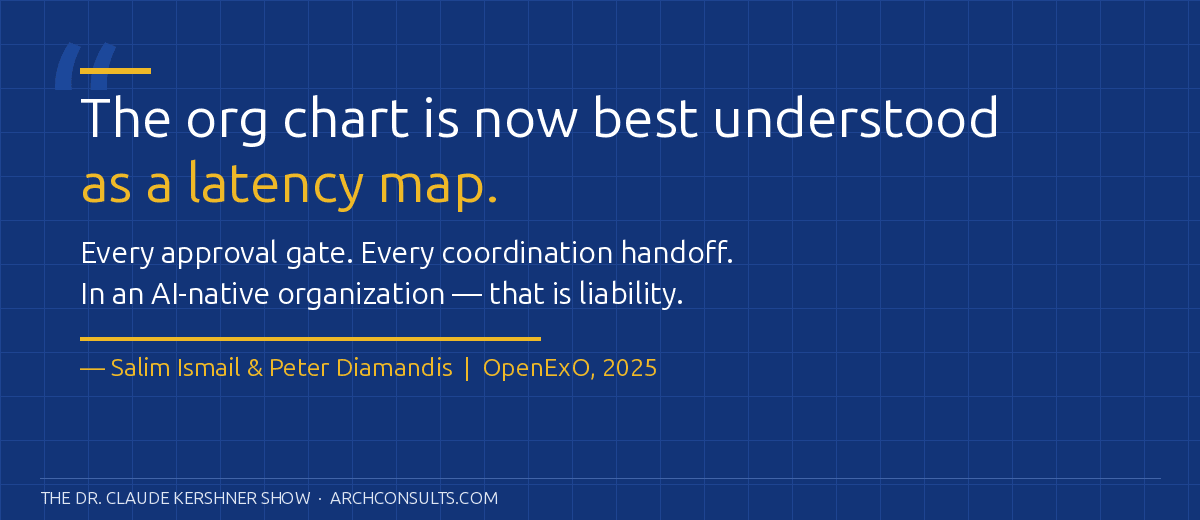
Ismail has argued that the org chart is now best understood as a latency map. Every layer of management, every approval gate, every coordination handoff represents delay in the system. In an AI-assisted environment, most of that latency is overhead. In an AI-native environment, it is liability.
The distinction between AI-assisted and AI-native is not a point on a continuum. It is a categorical difference in organizational logic. AI-assisted organizations add intelligence tools to existing processes. AI-native organizations redesign their processes around the assumption that intelligence is ambient and cheap. I am living that distinction right now — and it is real.
What Fifty Years of Organizational Scholarship Tells Us
Michael T. Hannan and John Freeman built the foundational framework here. In their landmark 1977 paper “The Population Ecology of Organizations” published in the American Journal of Sociology, they introduced structural inertia: the organizational tendency to resist environmental change — not because leaders are foolish, but because reliability and accountability are selection advantages that produce rigidity as a side effect. Their follow-up, Organizational Ecology (1989), was direct: organizations that cannot adapt to selection pressures are not reorganized. They are eliminated.
Arie de Geus, in The Living Company (1997), studied the world’s longest-lived corporations and identified four shared traits: sensitivity to their environment, a strong sense of cohesion and identity, tolerance for experimentation at the margins, and conservative capital management that kept strategic options open. These are precisely the traits that define organizational singularity readiness. De Geus’ long-lived companies were structurally prepared for disruption because they led with identity and judgment — not coordination efficiency.
The Entrepreneurial Imperative: Orientation, Intensity, and the Science Behind Both
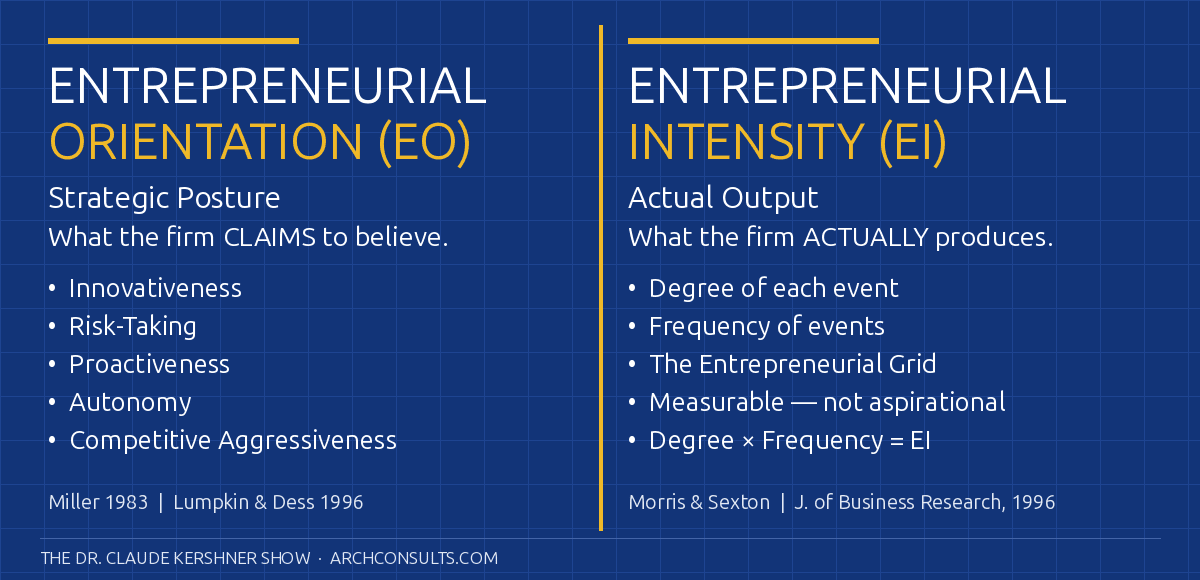
The first construct is Entrepreneurial Orientation (EO). Danny Miller first articulated it in his 1983 paper, identifying three core dimensions: innovativeness, risk-taking, and proactiveness. Jeffrey Covin and Dennis Slevin operationalized EO empirically in 1989. Gary Lumpkin and Greg Dess extended the framework to five dimensions in 1996, adding autonomy and competitive aggressiveness. EO describes the strategic posture of the firm — what it claims to believe about itself.
The second construct is Entrepreneurial Intensity (EI), developed by Dr. Michael Morris and Donald Sexton in their 1996 Journal of Business Research paper. EI is the product of two variables: the degree of each entrepreneurial event within the organization, and the frequency of entrepreneurial events over time. Their entrepreneurial grid plots these axes to produce a measurable picture of actual entrepreneurial output — not aspiration, not strategy documents, not pilot programs. Output.
EO is what an organization claims to believe. EI is what it actually produces. The companies failing at AI transformation are not failing because they lack the right mindset. They are failing because their entrepreneurial intensity is too low to match the frequency and degree of change the environment demands. The Organizational Singularity demands high EI. Now.
The Life Cycle Layer: Where ARCH Operates
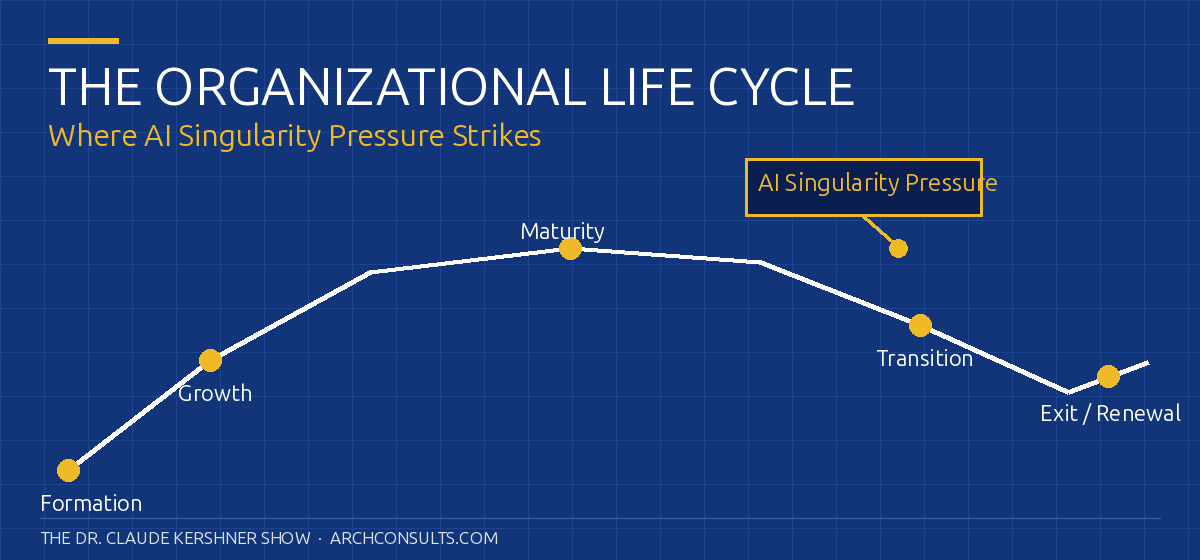
Organizations move through predictable life cycle stages: formation, growth, maturity, transition, and exit or renewal. This framework is the intellectual foundation of A.R.C.H. Consulting. My work is built around helping organizations navigate those transitions with clarity, structure, and the right leadership infrastructure in place.
The Organizational Singularity is not an external event that happens to organizations from outside. It is a life cycle pressure that manifests differently depending on where a firm sits in its own arc. A growth-stage company faces different inertial forces than a mature one. A family business navigating second-generation succession confronts the singularity very differently than a PE-backed firm preparing for exit.
The intervention cannot be the same across all contexts. This is the failure of most AI transformation consulting: treating the singularity as a technology problem with a technology solution, when it is a leadership and organizational design problem that requires deep life cycle awareness. That is what ARCH is built to solve.
The Fiduciary Wedge: Intelligence Is Cheap, Accountability Is Expensive
When coordination costs collapse — when AI handles the routing, the approval chains, the information relay functions that once justified layers of management — what actually survives?
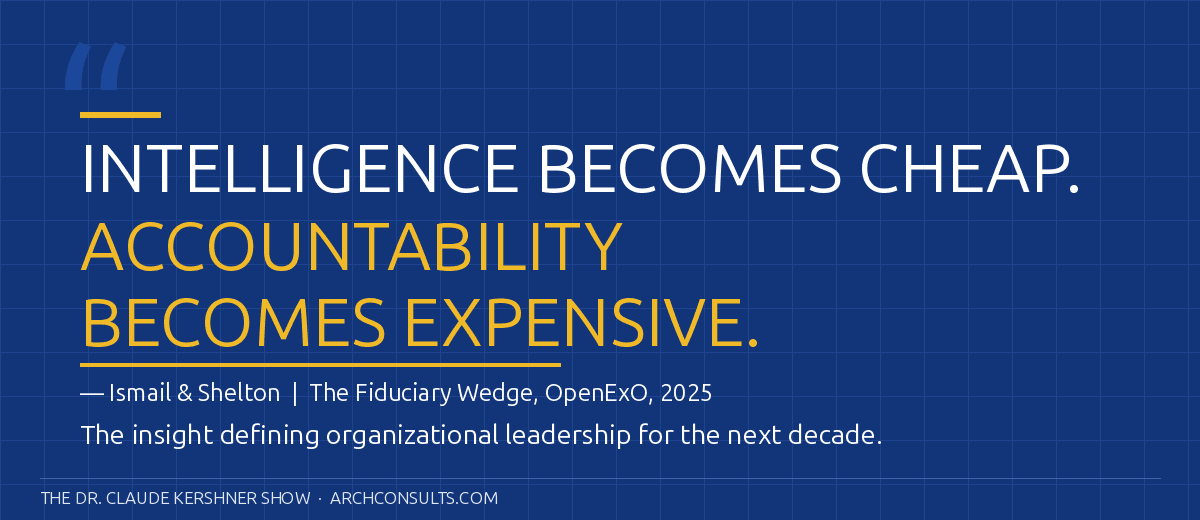
Ismail and Shelton call what remains the fiduciary wedge. What survives is accountability. Brand. Governance. Judgment. Purpose. The legal and moral entity the market trusts to carry liability, maintain ethical standards, and exercise judgment where no algorithm has standing.
Intelligence becomes cheap. Accountability becomes expensive.
For ARCH, the fiduciary wedge is not abstract. It is the precise description of the value that interim leadership, succession planning, and operating system implementation deliver in an AI-saturated environment. As AI absorbs more of the coordination function, the organizations that survive will be the ones who know who is accountable, who holds judgment, and who carries the organizational purpose forward through the transition. That is a leadership problem. And it is the problem ARCH is built to solve.
What I Believe — And What I Am Ready to Do About It
I started this piece with a personal observation. Let me be direct about what I have concluded from the experience of building a fully AI-integrated practice from the ground up — using AI agents, fully owned data, and tools I now depend on daily to run every aspect of my professional operation.
The organizational singularity is real. The scholarship supports it. The lived experience confirms it — and I am living it right now, in real time, inside my own work. And the most dangerous response any leader can have is to treat this as someone else’s problem to solve in someone else’s timeline.
The organizations that will survive this moment are not the ones with the best AI tools. They are the ones with the highest entrepreneurial intensity — taking bold, frequent, purposeful action to redesign themselves around intelligence, while preserving the accountability and judgment that no tool can replicate.
The asteroid has hit. Most companies just haven’t looked up yet.
When you are ready to look up — and when you are ready to do something about what you see — you know where to find me.
🔬 Continue the Research — The Kershner Lab
The frameworks referenced throughout this article — Hannan & Freeman’s organizational ecology, Morris & Sexton’s entrepreneurial intensity model, Lumpkin & Dess on entrepreneurial orientation, de Geus on organizational longevity — are part of an ongoing research practice I’ve been building and refining for years inside the classroom and in the field.
The Kershner Lab is the living repository for that work — reading lists, research papers, frameworks, tools, and field notes from the intersection of leadership science and organizational practice. If this article resonated, the Lab is where to go next.
Ep. 107: The Organizational Singularity — Why Your Org Chart Is a Liability
About the Author
Dr. Claude B. Kershner IV, DBA is the Managing Principal of A.R.C.H. Consulting, LLC and a full-time Professor of Leadership and Management Innovation at Miami Dade College. His work sits at the intersection of organizational life cycle theory, entrepreneurial science, and the practical demands of leading organizations through transition. He consults with founders, executives, and boards on interim leadership, operating system implementation, succession planning, and exit strategy.
📞 (786) 379-5673 | Miami & Ocean Reef Club, FL
🌐 archconsults.com | thedrclaudekershnershow.com
References
Coase, R. H. (1937). The nature of the firm. Economica, 4(16), 386–405. Link
Covin, J. G., & Slevin, D. P. (1989). Strategic management of small firms in hostile and benign environments. Strategic Management Journal, 10(1), 75–87. Link
de Geus, A. (1997). The living company. Harvard Business School Press. Link
Hannan, M. T., & Freeman, J. (1977). The population ecology of organizations. American Journal of Sociology, 82(5), 929–964. Link
Hannan, M. T., & Freeman, J. (1989). Organizational ecology. Harvard University Press. Link
Ismail, S., & Shelton, T. (2025). The fiduciary wedge. OpenExO. Link
Lumpkin, G. T., & Dess, G. G. (1996). Clarifying the entrepreneurial orientation construct. Academy of Management Review, 21(1), 135–172. Link
Miller, D. (1983). The correlates of entrepreneurship in three types of firms. Management Science, 29(7), 770–791. Link
Morris, M. H., & Sexton, D. L. (1996). The concept of entrepreneurial intensity. Journal of Business Research, 36(1), 5–13. Link
Free · 5 minutes · The Kershner Lab
How ready are you to lead in the AI era?
A free five-minute self-assessment from The Kershner Lab scores your AI literacy, judgment, adaptability, and people leadership, with personalized strengths and next steps.
Take the AI-Era Leadership Readiness assessment → See all assessments