Build a Business Beyond the Founder: What Great Man Theory Misses
Founder influence matters. So does the leadership team that can carry the business forward.
In the latter part of my father’s career, preparing other people to carry on without him became part of everyday work. He would ask what we would do if he were not there. He wanted people beside him in meetings, listening on phone calls, and learning to handle situations themselves.
Our drives to and from work were often another part of that education. We talked about business, the people involved, and the reasoning behind decisions. By working alongside him, we learned more than a sequence of tasks. We saw how he behaved, how he handled conversations, whom he knew, and why those relationships mattered. He made a point of getting us in front of the people he knew.
Looking back, I see that as an effort to make his knowledge usable by other people. Much of it was tacit: judgment developed through experience, difficult to capture fully in a manual. He shared it through conversation, observation, introductions, and practice. Preparation for his departure was something he kept returning to while he was still there to help.
That experience shapes how I think about leadership today. A customer will speak only to the owner. A proposal waits for the founder’s approval. A capable team pauses because nobody knows who can make the call. These are ordinary small-business problems, and they raise a larger question: how much of the enterprise depends on one person being available?
NVIDIA’s November 12 announcement that Jensen Huang had resigned as CEO, with Colette Kress appointed interim CEO, has made that question unusually visible. The company’s announcement recognized Huang’s contribution while emphasizing the leadership team that would continue its work. Both deserve attention. An interim appointment, by itself, tells us neither that succession preparation was adequate nor that none existed. [1]
For owners, managers, and agile teams, the useful lesson reaches beyond the headlines. We can acknowledge extraordinary founders while asking whether their influence is becoming a durable capability of the business.
What is Great Man theory?
Great Man theory explains history primarily through exceptional individuals. Thomas Carlyle gave it its best-known nineteenth-century expression in On Heroes, Hero-Worship, and the Heroic in History. Its historical label reflects the male-centered assumptions of that period. In business, a related habit appears when we explain an organization’s success almost entirely through its most visible executive. [2]
This is different from saying individual traits never matter. Confidence, expertise, judgment, and persistence can matter greatly. The question is whether the person at the top provides a complete explanation for what a company achieves.
I explored that distinction in Are Leaders Born or Made? 5 Leadership Myths, Debunked. The discussion starts with Great Man theory and returns to the people doing the work. It also considers Huang as an example of a recognizable leadership style. The episode is a useful companion to the question we face now: what happens when a business must carry forward more than its founder’s personality?
The evidence does not make founders irrelevant
Leadership research offers a caution about the stories observers tell. James Meindl, Sanford Ehrlich, and Janet Dukerich’s research on the romance of leadership examined how people attribute organizational outcomes to leaders. A visible individual can become an appealing explanation for a complex result. [3]
But dismissing the individual would be an equally incomplete response. Alison Mackey’s research found substantial CEO effects on firm performance, varying with the setting and level of analysis. Leaders are not interchangeable merely because they operate within systems. [4]
Founder research provides another counterweight. Rüdiger Fahlenbrach’s 2009 study found differences in investment behavior and performance between founder-CEO and successor-CEO firms. In its 1993–2002 sample, an equal-weighted founder-CEO strategy produced an annual benchmark-adjusted return of 8.3%; the reported abnormal return remained 4.4% after additional controls. [15]
Those historical findings deserve respect. They do not establish that keeping any particular founder in office causes superior future returns. The firms were not randomly assigned founders, and their characteristics differ. Nor does a portfolio comparison tell an owner that developing a successor would destroy the business.
When founder leadership becomes an investment strategy
There are funds built around this premise. The Founders 100 ETF’s prospectus defines founder leadership through a founder serving in a chief-officer role, which can include CEO, CTO, or scientific and medical leadership. It requires at least 90% of assets in founder-led companies, while allowing a limited non-founder allocation. [16]
In a September 2026 conversation with Barry Ritholtz, portfolio manager Michael Monaghan described a founder’s departure as the principal reason his strategy would sell a stock. That is a real expression of the thesis you hear in financial markets: the founder’s continuing involvement is part of what the investor is buying. [17]
Definitions still matter. The separate Founder-Led ETF, FDRS, uses an index whose eligibility includes an original founder in a C-suite or equivalent executive role, rather than requiring the CEO title alone. Its prospectus describes quarterly reconstitution. It would be inaccurate to say every founder-focused fund sells immediately whenever a founder changes titles. [18]
A sale under a founder-focused mandate is a portfolio decision under that strategy. It is not, by itself, evidence that the departing founder left an incapable organization. An investor can prefer founder exposure while a board has a different obligation: preparing the company to function through an eventual transition.
Take the relationship argument seriously
Jacob Morgan’s November 13 Future Ready Leadership episode description emphasizes Huang’s decades of relationships with world leaders, cloud providers, and AI laboratories. Its opening chapter also recognizes the liability of becoming indispensable. That is a stronger argument than simple celebrity worship. [11]
Personal trust cannot be reassigned with an announcement. A founder may know whom to call, understand a partner’s unspoken concerns, and have the credibility to resolve uncertainty quickly. A successor inherits the position before inheriting that history.
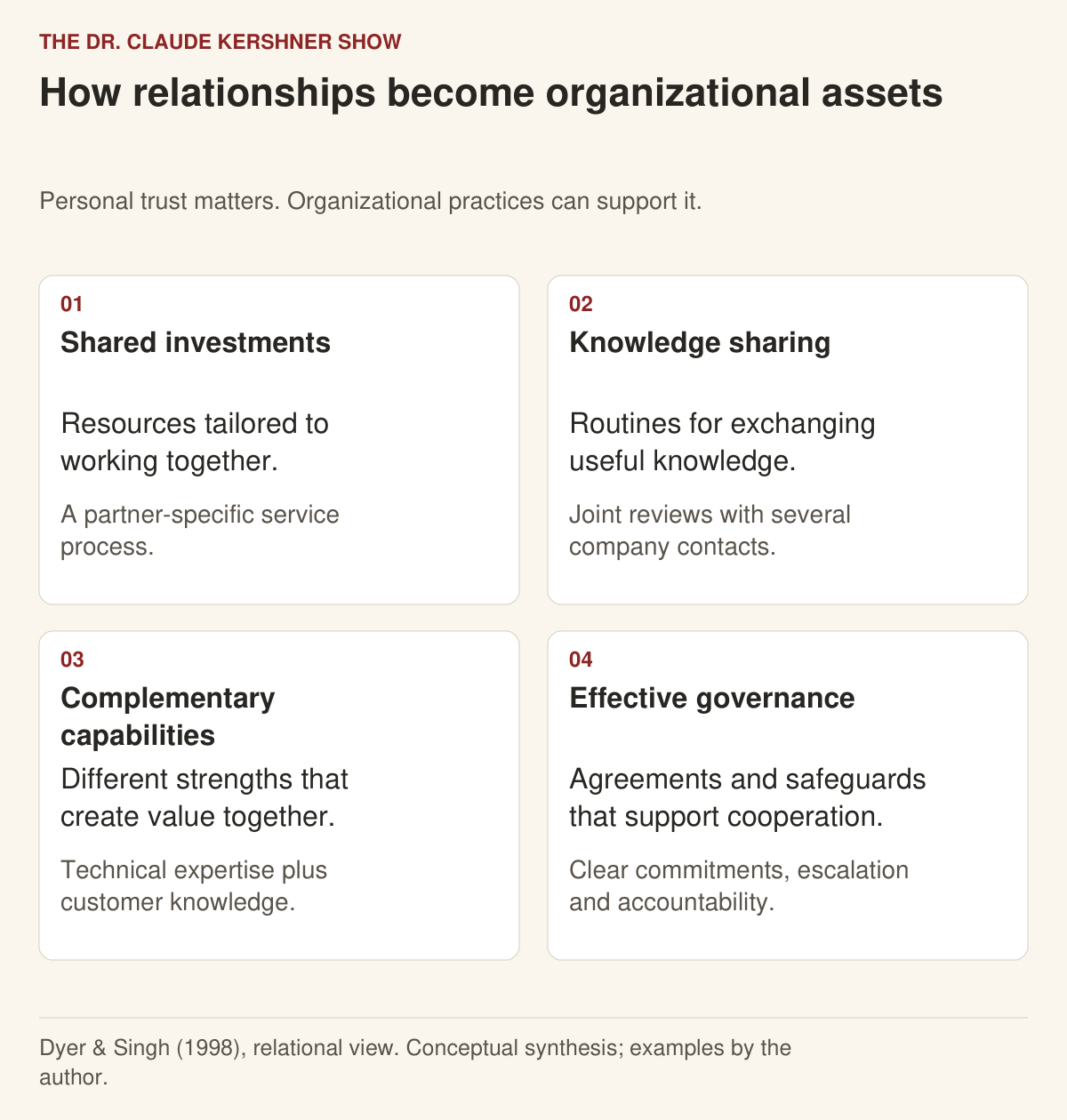
Yet partnerships can develop additional foundations. Dyer and Singh’s relational view identifies potential advantage in interfirm investments, knowledge-sharing routines, complementary capabilities, and governance. This is a scholarly theory of how relationships can create value, not proof that NVIDIA or any particular business has institutionalized its partnerships. [12]
For a service-business owner, the practical question is familiar. Does the major customer trust only you, or also the operations manager who resolves problems and the account lead who understands the work? Those relationships do not erase your contribution. They make more of the customer’s experience dependable when you are elsewhere.
Steve Jobs is also a succession example
The Jobs story is often invoked as evidence of the irreplaceable founder. Its succession chapter belongs in the discussion, too. Apple’s August 2011 announcement said Jobs recommended implementing the succession plan and naming Tim Cook CEO. It described Cook’s thirteen years at Apple and his substantial operating responsibilities. [19]
Pixar’s own history likewise includes a technical organization and Ed Catmull’s work before Jobs purchased Lucasfilm’s computer division in 1986. Jobs’s contribution was consequential, but the story did not begin and end with him. [20]
These cases are illustrations, not controlled experiments. They remind us that recognizing an exceptional person and recognizing the organization around that person are compatible.
Building a management team is an early design decision
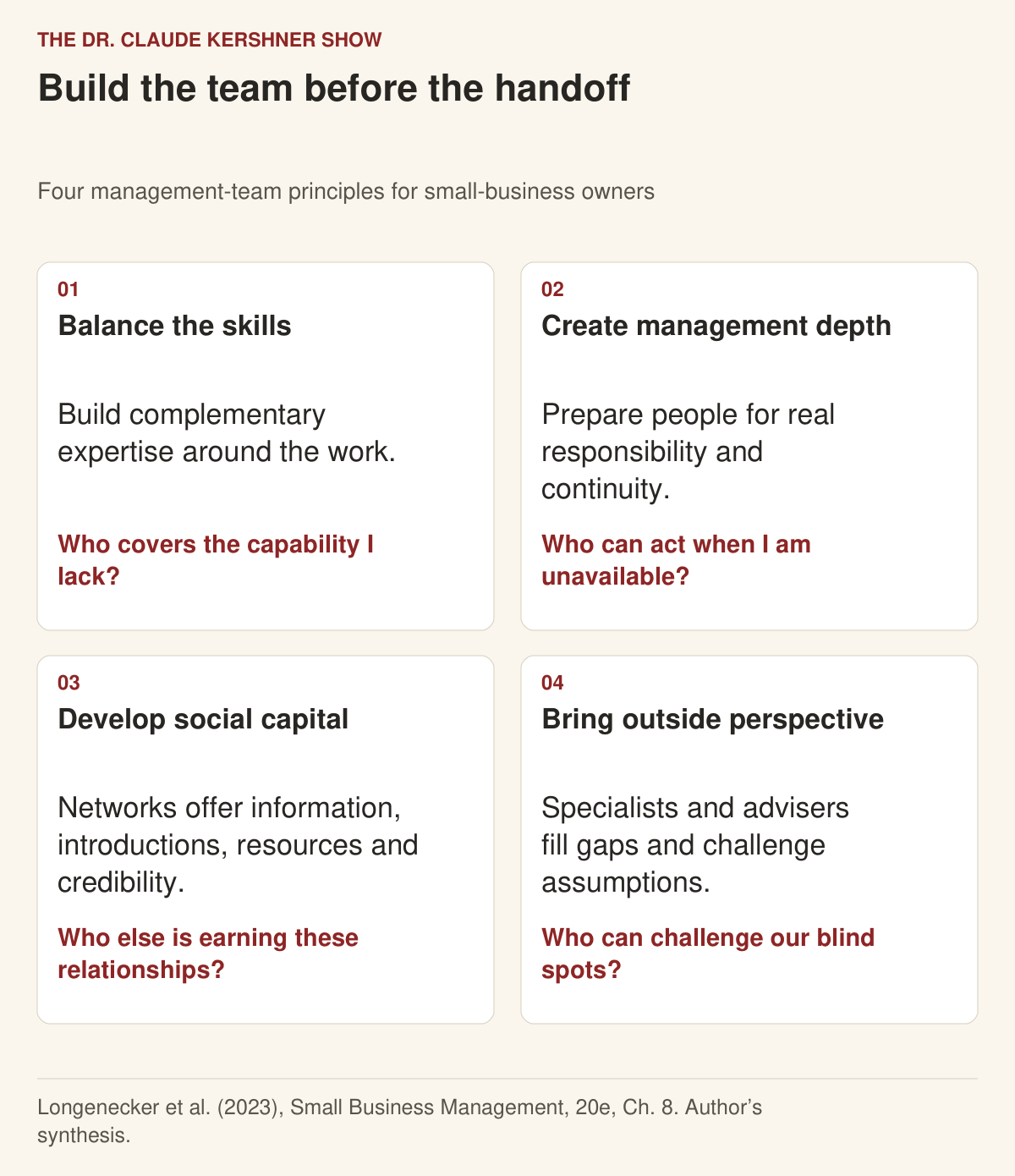
These ideas also appear near the beginning of the organizational plan in Longenecker, Petty, Palich, and Hoy’s Small Business Management. Chapter 8 emphasizes a team’s mix of talents and its contribution to continuity. It describes networks as sources of information, resources, and credibility, and explains how outside specialists and advisers can supplement internal expertise. [21]
Four points travel well from a new venture to a much larger company: balance the skills around the table; develop depth beyond one manager; invest in relationships; and invite informed outside perspective. For a solo owner, this can begin with trusted specialists and advisers rather than a full executive team. For a large company, the scale and governance are different, but the questions remain relevant.
My inference is straightforward: continuity belongs in the design of the business long before a departure forces the issue. That does not establish whether NVIDIA’s preparations were sufficient. It identifies what owners, directors, and leadership teams can reasonably examine.
Watch the companion conversation
Ep. 123: Are Leaders Born or Made? 5 Leadership Myths, Debunked
What a company needs to carry forward
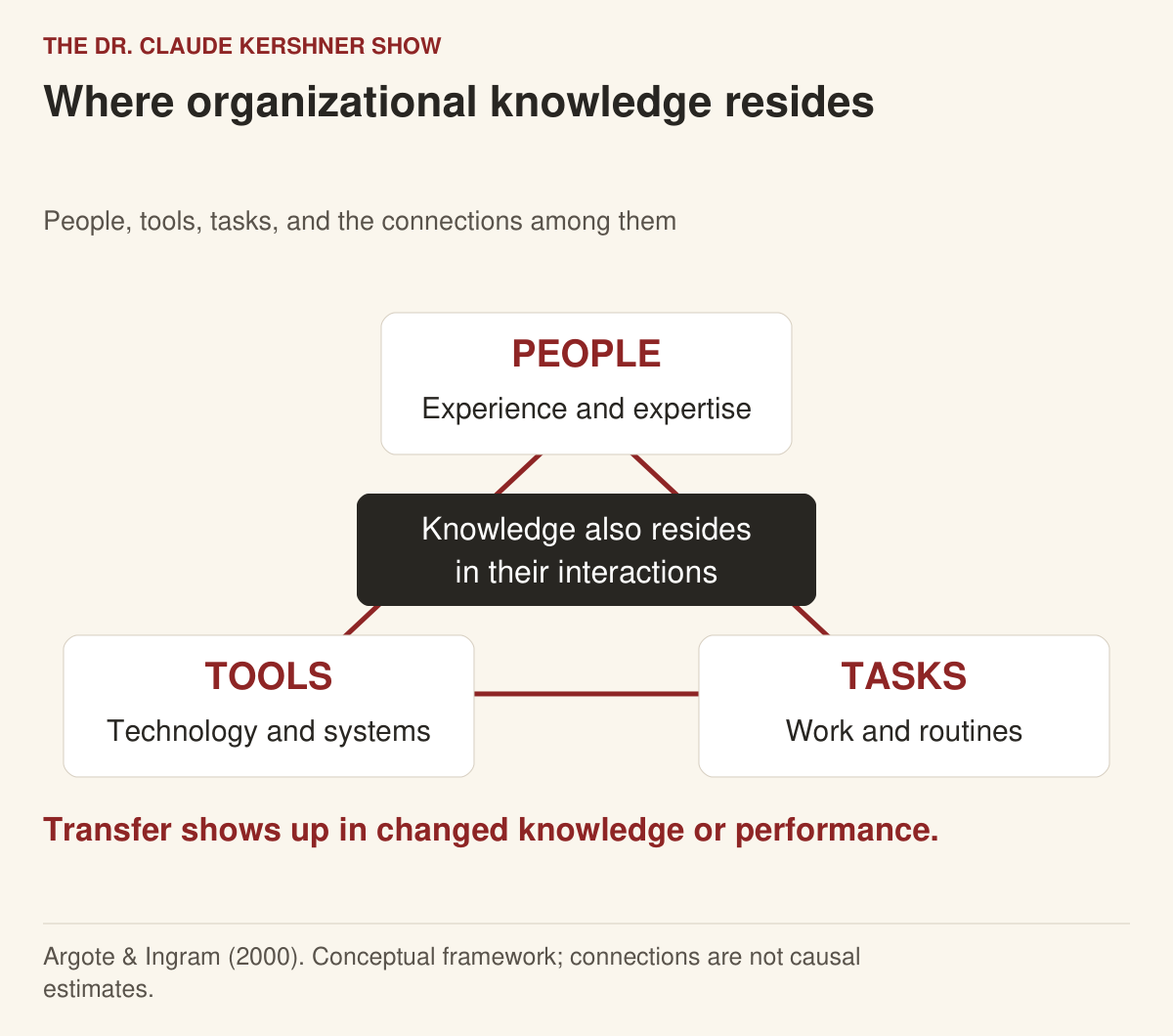
Organizational knowledge does not live only in a founder’s head or a procedure manual. Argote and Ingram locate it in people, tools, tasks, and their interconnections. Tacit expertise can be difficult to articulate. Transfer becomes meaningful when another person or unit knows more or performs differently because of what has been shared. [13]
That gives an owner a practical distinction: sending the team a document is an activity; watching a colleague handle the situation competently is evidence of capability. Explain why you priced a difficult job, let another leader run the next customer review, and discuss the reasoning afterward.
Leadership can also be developed. Lacerenza and colleagues’ meta-analysis of 335 independent samples examined four outcomes: participants’ views of the training (reactions), what they learned (learning), whether they used it on the job (transfer), and changes in performance outcomes (results). Each dot shows the combined estimate across the studies for that outcome; farther right means a larger positive effect on a common statistical scale, not a percentage improvement. The horizontal lines show the uncertainty around each estimate: shorter lines mean greater precision, and zero would mean no measured effect. [14]
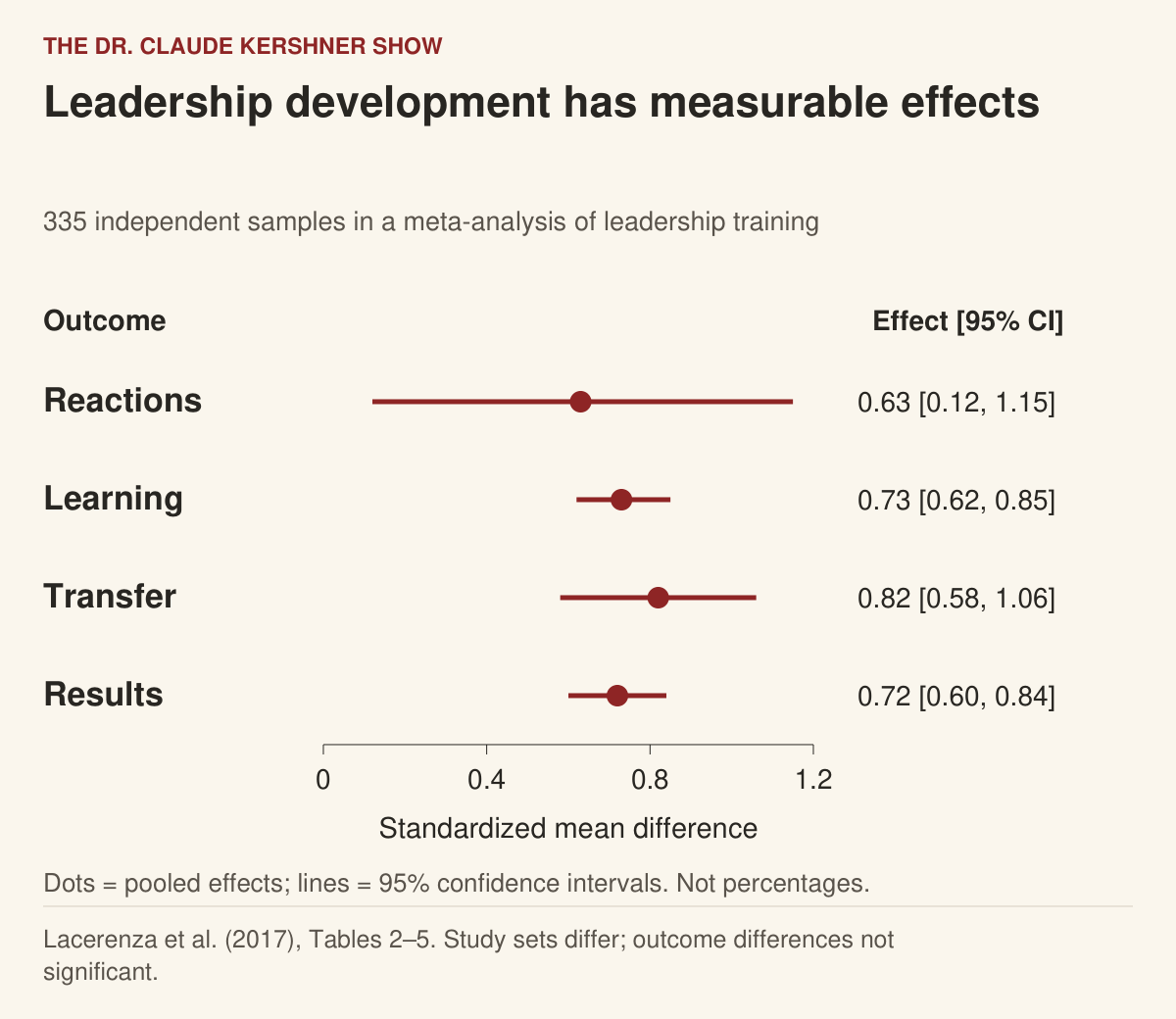
The takeaway: all four estimates, including their confidence intervals, are above zero, so the findings extend beyond participants liking a workshop to learning, applying skills, and performance outcomes. I include this chart because building the next leadership team depends on people developing capabilities; for an owner, it supports investing in development and checking whether people use what they learn at work. It does not show that transfer is definitively the strongest outcome, since the four overall effects did not differ significantly, or guarantee that training will produce a successful CEO transition.
Shared leadership adds another piece. Wang, Waldman, and Zhang combined 42 independent samples and found a positive association with team effectiveness, with a corrected correlation of .34. That is team-level evidence, not a 34% improvement or proof of firm-level causation. It supports examining leadership across the team, alongside formal authority. [5]
For a small business, succession starts in the work
My view is that leaving an inevitable leadership transition unprepared is a serious weakness in company building. That is a management judgment, not a claim that research promises a painless handoff. The point is to prepare while the business still has time to learn.
A ten-person company does not need to imitate a public-company board. It does need clarity about who runs operations, who protects customer commitments, and who can act when the owner cannot. Ownership transfer and operational succession are related, but they are not the same decision.
For an agile team, the equivalent problem is a founder who informally overrides priorities or becomes the approval point for every release. Short meetings and flexible job titles do not remove that dependence. Clear authority, shared information, and review of actual outcomes are more useful tests.
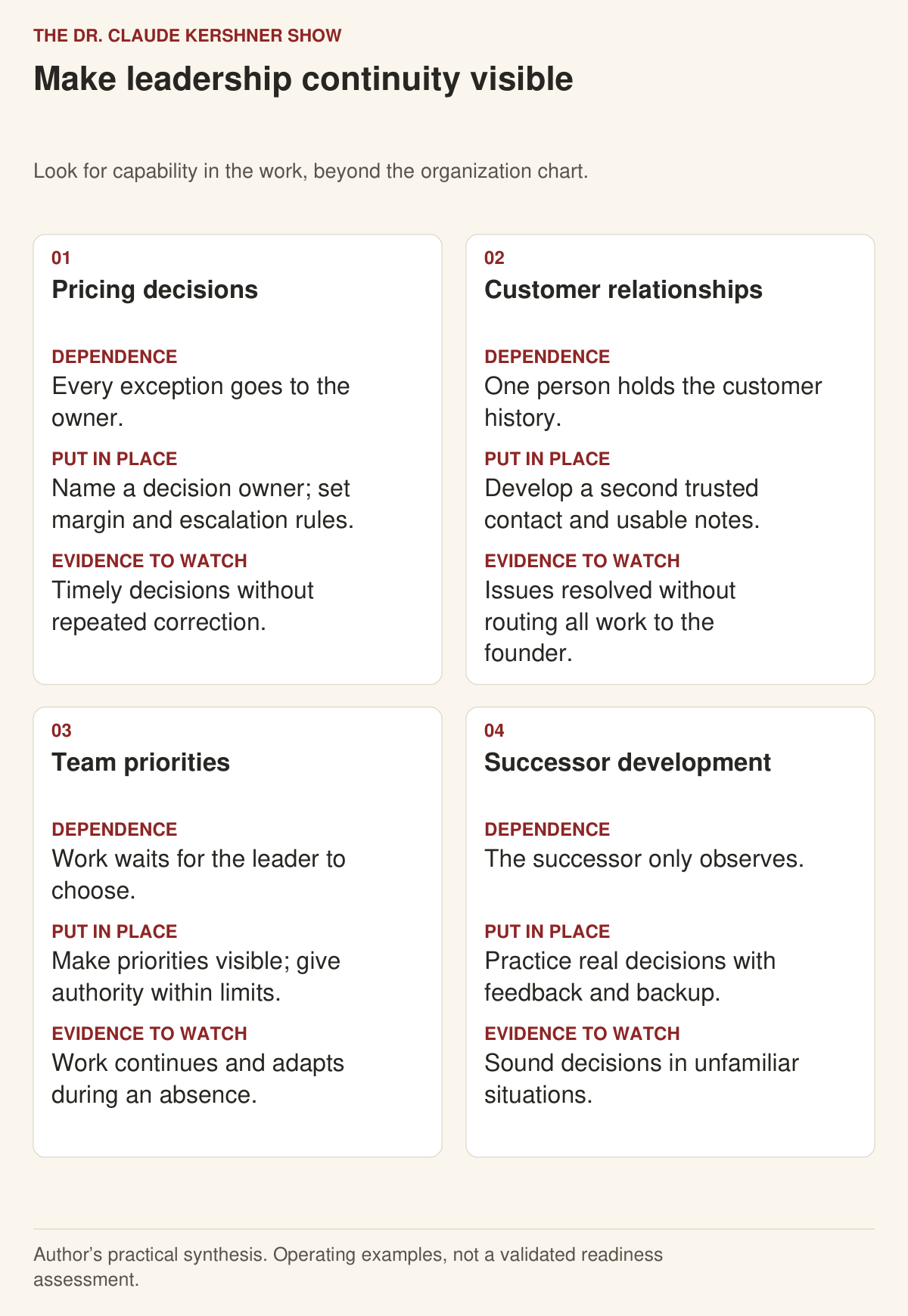
This builds on Field Fluency: understand the conditions in which people must perform. It also connects with Organizational Design Is Personal: responsibility is usable only when authority, information, and coordination fit the work.

Patrick Lencioni’s work directs attention toward trust, productive disagreement, commitment, accountability, and collective results. Gino Wickman’s Traction and EOS direct attention toward responsibilities, information, processes, priorities, and execution. These practitioner frameworks offer practical disciplines; they are not scientific guarantees. They help make the less visible work of building a leadership team more concrete. [8] [9]
Recognizing the responsibility is not the same as preparing
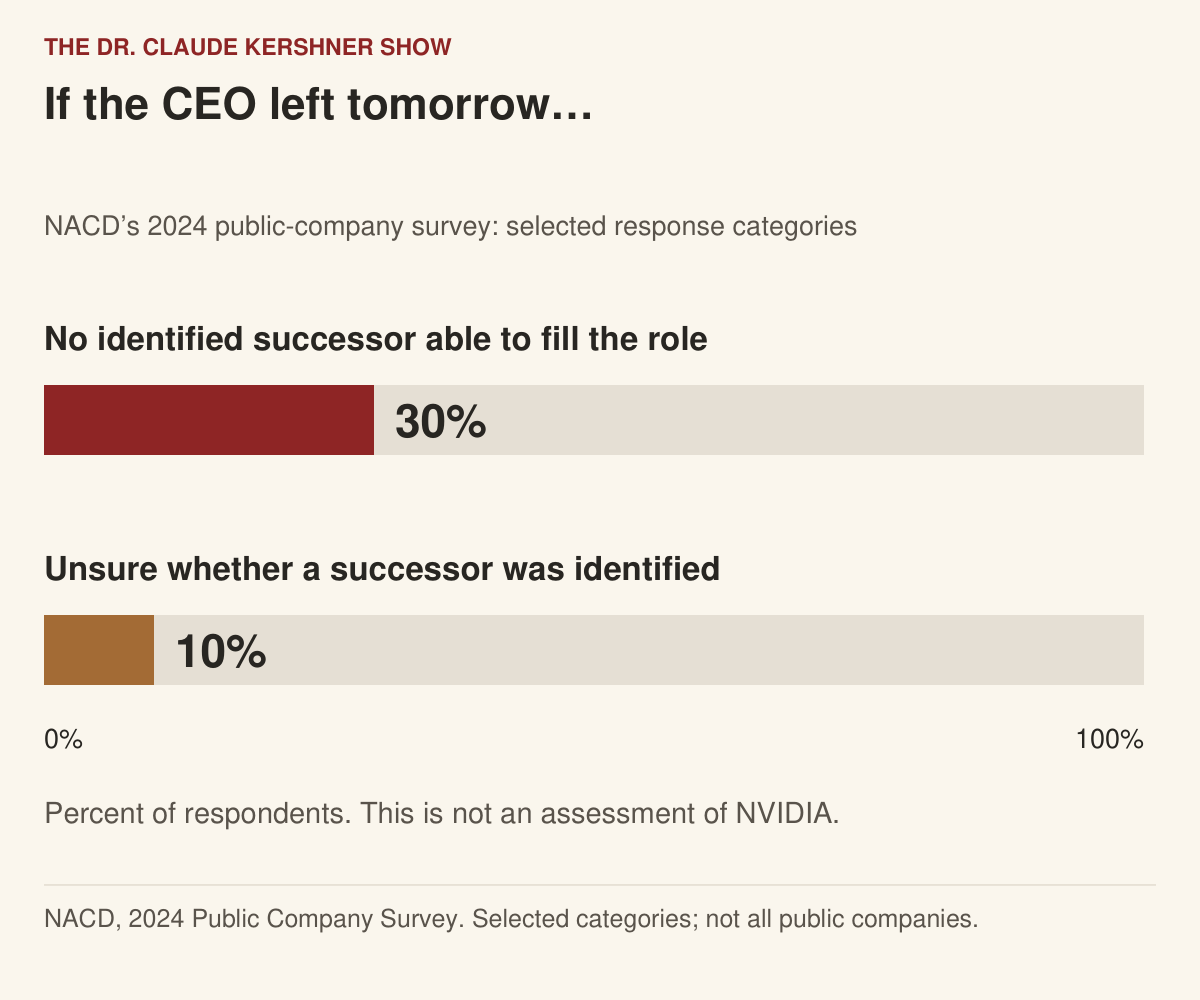
In NACD’s 2024 public-company survey, 30% of respondents said their board had no identified successor who could effectively fill the role if the CEO left tomorrow; another 10% were unsure. Those responses do not describe every company, and they are not an assessment of NVIDIA. They show that even where succession is a familiar responsibility, confidence in readiness varies. [6]
A founder can create value through vision and personal influence. A leadership team can create value by turning that influence into reliable decisions, relationships, and execution. An eventual transition tests both.
The question I would put to any owner is this: What can your company do well today because you have helped other people learn to do it without you?
That answer will not capture your entire contribution. It will reveal an important part of the business you are building.
Put this into practice
Take the free five-minute Leadership Effectiveness self-assessment to reflect on your leadership and identify a practical next step. No login required.
Explore the Kershner Lab’s leadership frameworks, listen to What Moves People: Motivation, Communication & Leading Teams, or bring a leadership-team challenge to the show.
Evidence and editorial notes: Current-event context checked November 17, 2026. Morgan’s position is drawn from the published episode description and chapter headings; the full transcript was unavailable. The companion episode’s automated captions were reviewed. Fund examples describe investment approaches, not investment recommendations. The author’s operating examples are identified separately from research findings. The opening recollection is the author’s personal account. The cover uses his father’s photograph with AI-assisted composition. The field photograph uses the show’s existing crew image with AI-assisted typography editing. New conceptual diagrams are credited separately from empirical charts.
Research and sources
- NVIDIA, CEO transition announcement, November 12, 2026
- Thomas Carlyle, On Heroes, Hero-Worship, and the Heroic in History (1841)
- Meindl, Ehrlich, and Dukerich (1985), The Romance of Leadership, Administrative Science Quarterly, 30(1), 78–102; ERIC research record
- Alison Mackey (2008), The effect of CEOs on firm performance, Strategic Management Journal, 29(12), 1357–1367
- Wang, Waldman, and Zhang (2014), A meta-analysis of shared leadership and team effectiveness, Journal of Applied Psychology, 99(2), 181–198
- NACD, Survey Analysis: CEO Succession Planning, August 28, 2024
- BlackRock Investment Stewardship, 2025 Annual Report, discussion of executive succession
- The Table Group, The Five Dysfunctions of a Team: A Practical Guide for Leaders
- EOS Worldwide, How the EOS System Works: Understanding the EOS Model and Six Key Components
- Jim Collins, Clock Building, Not Time Telling, from Built to Last with Jerry Porras
- Jacob Morgan, Future Ready Leadership, November 13, 2026: publisher episode description and chapter headings
- Dyer & Singh (1998), The Relational View, Academy of Management Review, 23(4), 660–679
- Argote & Ingram (2000), Knowledge Transfer: A Basis for Competitive Advantage in Firms, Organizational Behavior and Human Decision Processes, 82(1), 150–169
- Lacerenza, Reyes, Marlow, Joseph, & Salas (2017), Leadership Training Design, Delivery, and Implementation: A Meta-Analysis, Journal of Applied Psychology, 102(12), 1686–1718
- Fahlenbrach (2009), Founder-CEOs, Investment Decisions, and Stock Market Performance, Journal of Financial and Quantitative Analysis, 44(2), 439–466
- Founders 100 ETF (FFF), Summary Prospectus, November 24, 2025
- Barry Ritholtz with Michael Monaghan, At the Money: Investing in Founder-Led Companies, September 2026
- Founder-Led ETF (FDRS), Summary Prospectus, December 30, 2025
- Apple, Steve Jobs Resigns as CEO of Apple, August 24, 2011
- Pixar Animation Studios, Our Story
- Longenecker, Petty, Palich & Hoy (2023), Small Business Management: Launching & Growing Entrepreneurial Ventures, 20th ed., Chapter 8: The Organizational Plan: Teams, Legal Structures, Alliances, and Directors